

2. Taurus
The Bull of Heaven


Symbol: ♉️
What the constellation represents: a bull
Region of sky where it is located: northern hemisphere
When visible: September-mid April
How visible: very easy
Objects of interest: bright star Aldebaran, Hyades cluster, Pleiades cluster, Crab Nebula
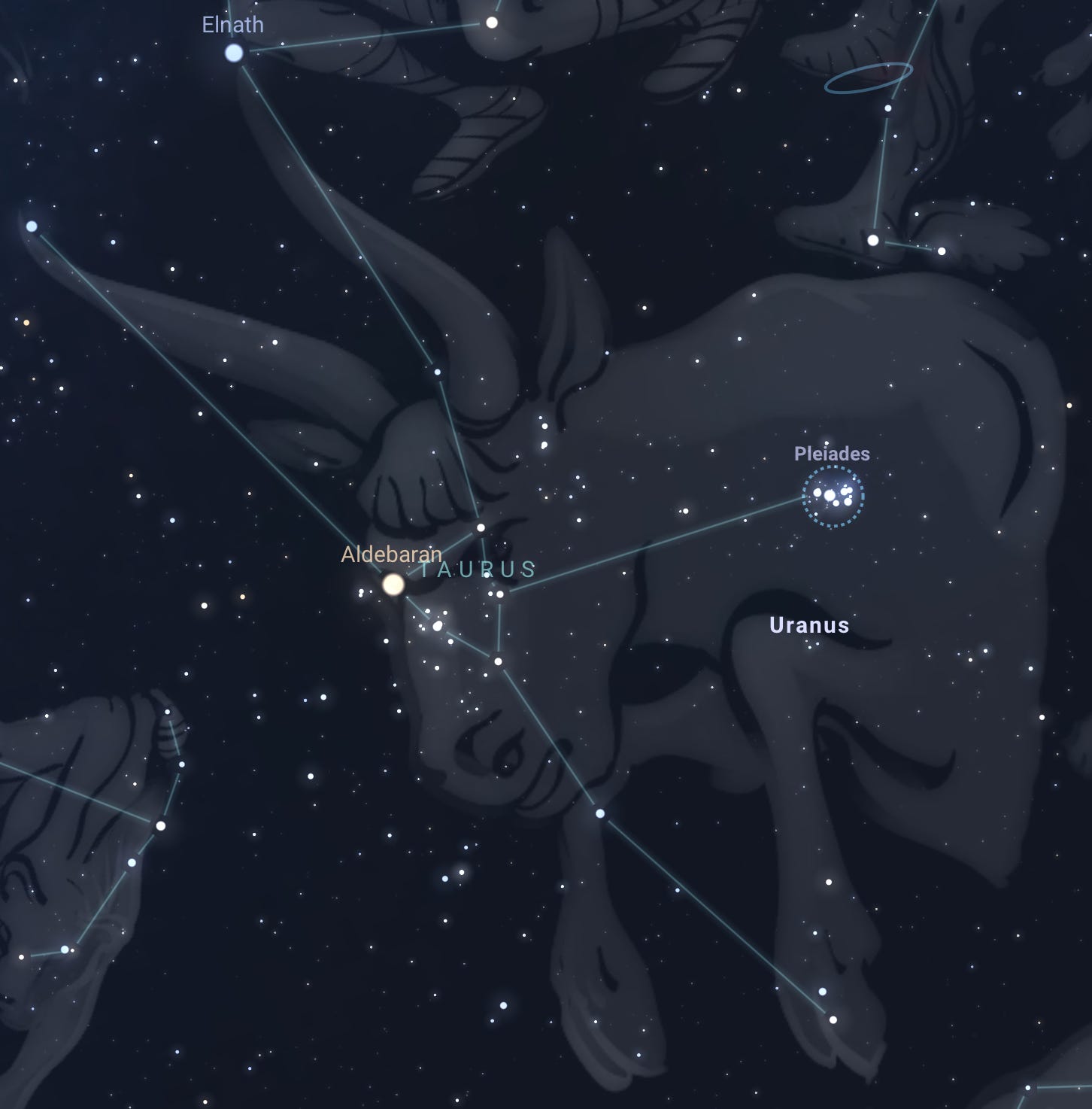
How to see it: Taurus is one of leading constellations of winter skies. Use Orion’s belt to locate the constellation - follow a line from the three stars up and to the right, and you will reach a reddish star - that’s Aldebaran - and the Hyades, a V-shaped pattern of stars, representing the bull’s face. Extending the V of the Hyades outward will lead to two other stars representing the bull’s horns, and the Pleiades are on the bull’s back.
Read my previous article about Taurus here:

‘The Bull looks a meanie, but he’s on our side, and he helps the Plough which combs and divides…’
Johnny Flynn, ‘Einstein’s Idea’
The ink-black winter nights are uplifted by some of the sky’s most beautiful constellations and brightest stars. Orion leads the charge, his figure ablaze with distant supergiant suns, and the brilliant Dog Star Sirius yaps at his heels. Gentle Auriga with his pet goat watches from the zenith, and nudging up to Orion, almost goading the hunter with jutting horns and an angry red eye, is the mighty bull Taurus, the zodiac constellation that might be the oldest of the twelve.
In the caves of Lascaux, France, there is a prehistoric painting of a speckled bull dating to ~15,000 BCE. It looks uncannily like Taurus as depicted on star maps to this day, with spots on the animal’s face that roughly correspond with stars in the Hyades cluster, and with another bunch of dots resembling the Pleiades cluster, even located in the same place in the painting as in the constellation. It’s an attractive theory that’s popular among astronomers, but less so among experts on Stone Age cave art, as there is debate about whether this painting actually shows Taurus or if the resemblance is coincidental. As Colin Stuart says: ‘The idea that Ice Age hunters might have watched the same stars is captivating. But the evidence isn’t conclusive. Lascaux’s artists left no explanations, only images. Archaeologists remain divided: are the dots a star map, or simply an artistic flourish?’
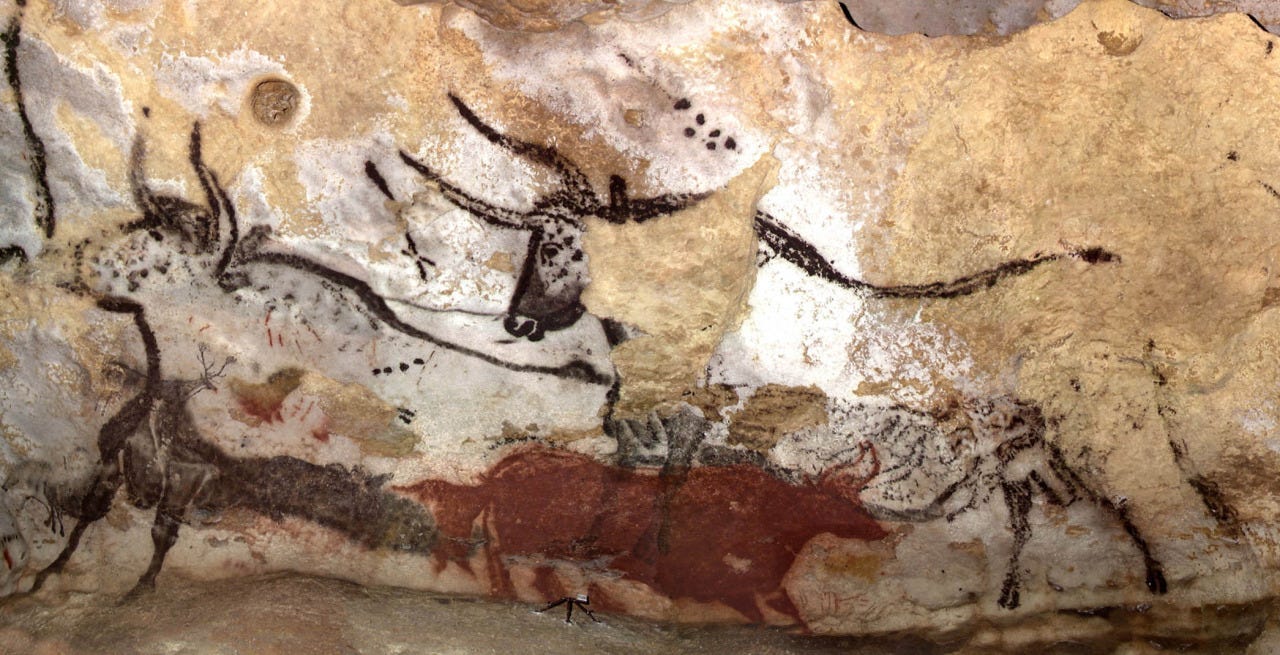
Archaeologists might think that archaeo-astronomers and others with their heads in the stars (erm, guilty as charged here!) are seeing things they want to see, such as star maps, where they shouldn’t. After all, one argument goes that this is a cave painting, and in a cave, one cannot see the stars outside! And those ‘Pleiades’ dots in the Lascaux art might also be a coincidence - another theory is that the dots often pictured next to animals in cave paintings represent their gestation periods, so nothing to do with stars.1
To find the first definitive documentation of this constellation, we look to the Bronze Age, and the region between the Tigris and Euphrates rivers. This was home to the Sumerian civilisation, where writing was invented, as well as the zodiac itself, and here, scribes recorded the earliest story ever written, which happened to mention a Heavenly Bull.
In the epic of Gilgamesh, the eponymous king, two thirds divine it was said, ruled over the city of Uruk. He was handsome and heroic, known for defeating monsters, but his arrogance often got the better of him. He had many adventures according to this epic, and the tale of how the bull ended up in the stars is one of them.
Once, the goddess Ishtar, who had a crush on Gilgamesh, came down to his palace. She appeared before him, beguiling and beautiful - she was the goddess of love, after all - but Gilgamesh was not interested. ‘Your majesty, darling, make me your wife. I will shower you with blessings beyond compare, and love without end!’ she said seductively, but Gilgamesh turned her down. ‘Great Ishtar, I respect your divinity, which is why I cannot lie with you, or be your husband. Besides, I know what happened to your previous lovers!’ he retorted. At this, she fumed with rage. After all, Ishtar wasn’t all ‘love and light’, she had a warrior side too, and heavens have no fury like a goddess scorned! She begged her father, the sky god Anu, to unleash Gu-anna, the great and terrible Bull of Heaven, upon Gilgamesh’s kingdom in revenge. She knew that this beast, known to cause earthquakes wherever he walked, would grab the king’s attention, yet another monster for him to attack. Anu refused her requests, but Ishtar was persistent. And so he relented, releasing the creature from his celestial cage onto the world below.
As the bull crashed to earth like a meteor, great tremors rumbled across the land louder than thunder, ripping chasms through the ground and making cities crumble. The huge beast lumbered about, breaking and destroying as he went. The kingdom of Uruk was in peril. ‘Please, your majesty, do something!’ the people pleaded. At this, Gilgamesh approached the bull, but even this god-sent monster seemed too much for him. But Enkidu, Gilgamesh’s best friend, was there to help. Enkidu was known for his brute strength and stamina. They worked together, with Enkidu pinning the thrashing bull down as Gilgamesh faced the beast in combat. After a long, hard fight, the king drew his sword and sliced the bull in half.
To mark his victory, the gods placed Gu-anna back in the sky, in the stars, but only the animal’s head and front quarters can be seen.
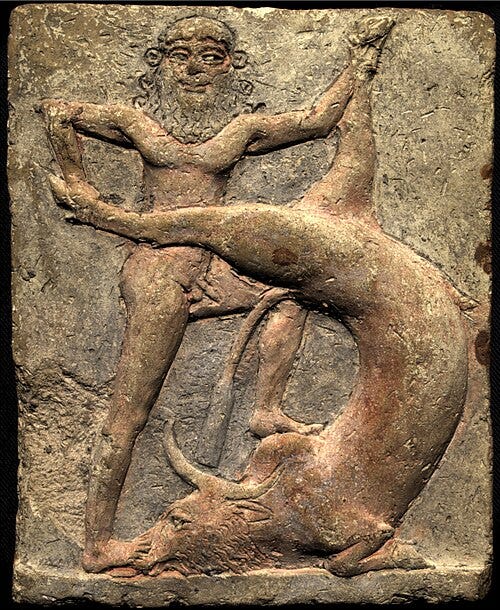
The presence of Ishtar in the myth is why in astrology, Taurus is associated with Venus, the planet the Babylonians associated with this goddess. It’s also thought that Gilgamesh was honoured as a constellation, some say as Hercules, and others think he became Orion, because of the way that Taurus and Orion appear locked in combat, the battle between man and beast frozen in starlight.
The Greek tales about this constellation are primarily associated with the island of Crete, home to the Cretan or Minoan people, who pre-dated the ancient Greeks by thousands of years. The Minoans, named by archaeologist Arthur Evans after the mythical King Minos, had a sophisticated civilisation with lavish, complex palaces such as that of Knossos, with many floors and rooms arranged in a way that could be seen as labyrinthine, thus the myth of the Labyrinth was born. This was where the monstrous half-man, half-bull Minotaur lurked. But was this monster a distortion of the Cretan bull cult? These animals, which were likely aurochs (an extinct species of wild cattle), were revered across Minoan society in their architecture and artefacts, as well as in the tradition of ‘bull jumping’ depicted in frescos. The bull was likely seen as a godly figure and much respected, though the fact that the Cretan script has not been deciphered means that much of Minoan life and belief remains a mystery. But the bulls made an impression on later Greek colonisers, who incorporated this theme into their myths about Crete, including their take on the origins of the Minoans. According to the story, the Phoenician princess Europa encountered Zeus, disguised as a white bull, who carried her across the sea to Crete and slept with her (typical!) with the product of their union being Minos, the eventual king of the island and builder of the Labyrinth. And Zeus’s taurine form was placed in the constellations to remember yet another one of his affairs…or maybe Taurus is there as a memory of the ancient Cretans and their divine bulls?
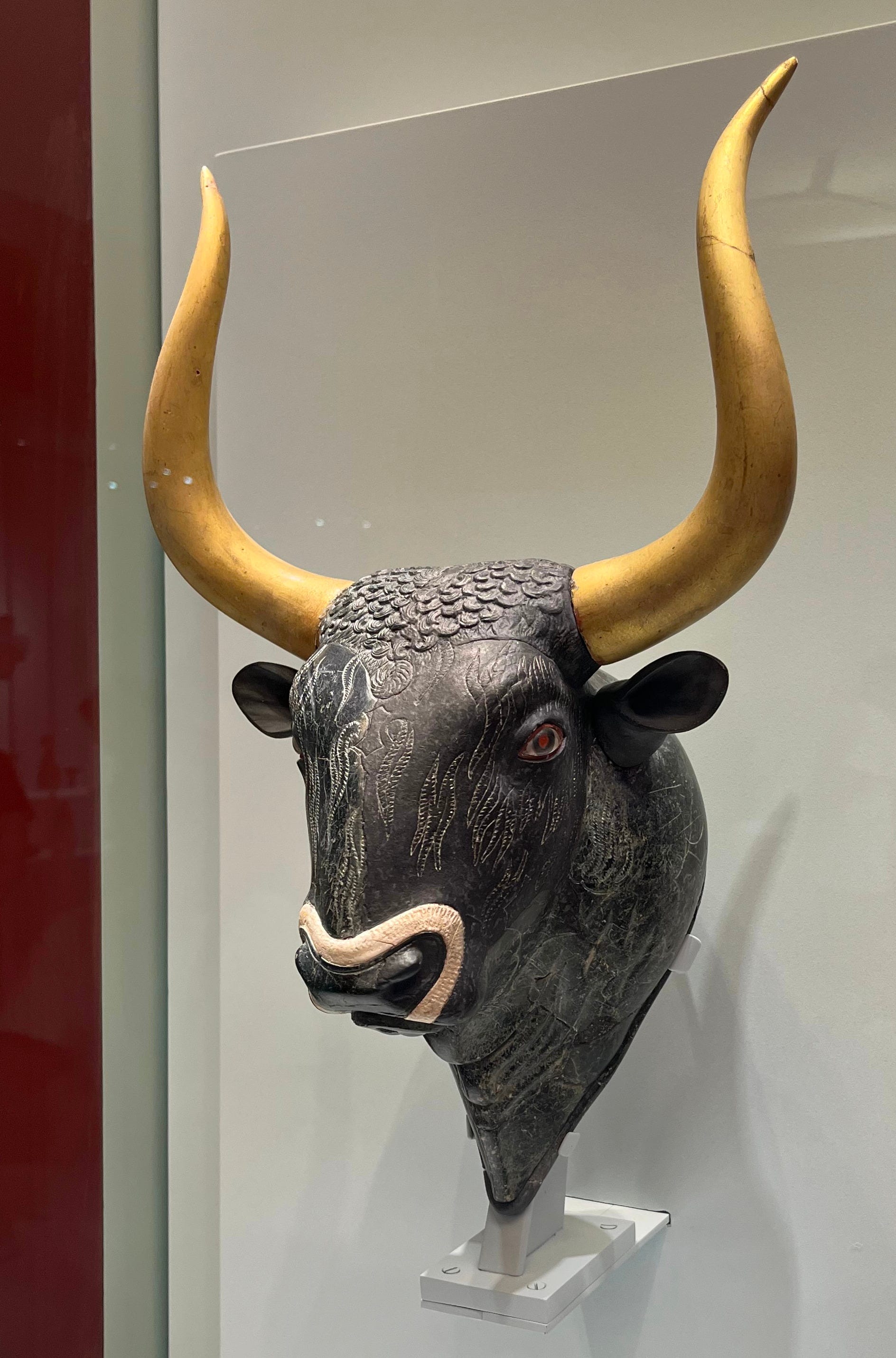
In Egypt, Taurus was also known as the Bull of Heaven, and associated with the Apis bull, an animal form of the god Osiris that represented virility and fertility. A bull would be chosen from a herd based on specific markings on the animal’s hide, and this special bull was kept in a sanctuary and indulged with the finest food and treated like a king, or a god. When the Apis bull died, he would be mummified like a pharaoh and laid to rest in a great granite sarcophagus, with all the pomp and ceremony of a royal burial.
Like Aries, Taurus has also been strongly associated with spring since the earliest times, and another reason (along with the cave paintings hypothesis) why Taurus is often said to be the ‘oldest zodiac sign’ is because prior to Aries hosting the coveted spring equinox point, the Sun was in the constellation of the Bull on the first day of spring. This occurred in 3000 BCE, around the time when we get our first astronomical records from Mesopotamia. Over time the equinox point slipped into Aries and the Sun passed through Taurus in May. The festival of Beltane, or May Day, happens during ‘Taurus season’, and this Celtic cross quarter day is full of bovine symbolism, such as driving bulls between bonfires for symbolic purification and pest removal, or ritualistically moving cattle to summer pastures.
In Wales, Taurus was known as Yr Ych, the Ox. This was one of the bulls tamed by Hu Gadarn, the heroic and legendary farmer who brought agriculture to Wales. During a battle with a monster called the Afanc, one of his oxen died, and was honoured in the sky with a constellation. Hu Gadarn was also placed in the stars as Boötes, the Ox Herd, who can be seen shining in the night sky when the sun enters Taurus.

Taurus in depth
The Hyades is the larger cluster in Taurus, and the closest open cluster to Earth at a distance of 150 light years. They are a mix of middle-aged stars and older stars at the end of their lives. The name means ‘rainy ones’ because their November setting marked the start of the rains in ancient Greece. These stars, along with the Pleiades, were also said to bring rain upon their rising. In myth, the Hyades were half sisters of the Pleiades. Their story is tragic - their brother, Hyas, was out hunting one day, and was killed by a lion. In their grief, the weeping sisters were placed in the sky, and this is why their presence causes the rain to fall. In other myths, the Hyades were the nurses of Dionysus, god of wine. Another translation of the name Hyades is piglets, and the Romans associated these stars with pigs rolling in mud, because of their association with rain.
A fascinating piece of folklore connects these stars with April showers. In the English folk song Green Grow the Rushes O, the lyrics are full of what might be celestial symbolism, including mention of the ‘April Rainers’, which Lia Leendertz thinks refers to the Hyades.2 She says it’s because of their rising in April, but the timing is a bit off in my opinion, because in April the cluster would be in the west by nightfall. So I think this is a reference to the Hyades undergoing ‘heliacal setting’, meaning that they set with the sunset, making their last appearance for the year.
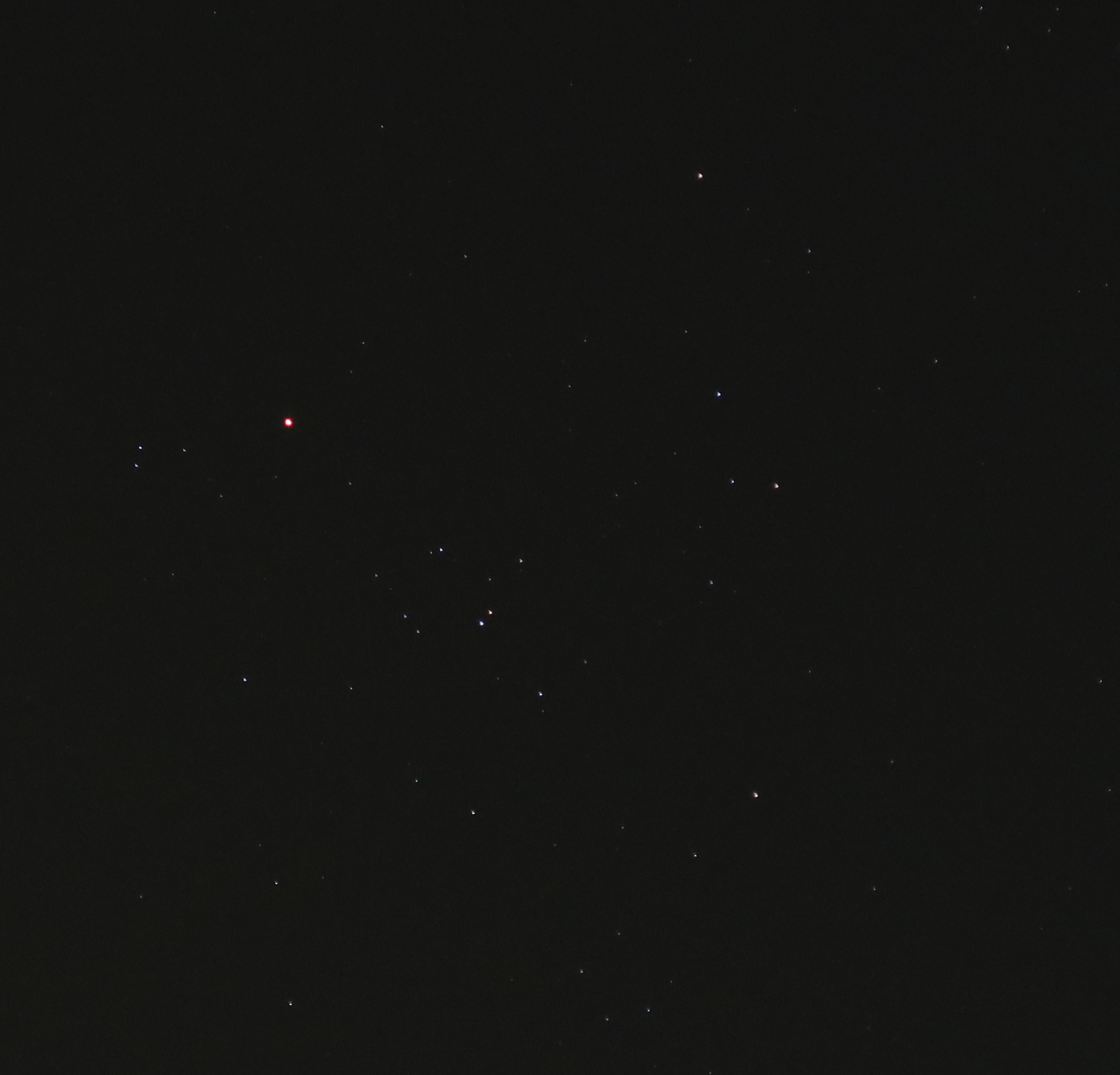
In winter, the Hyades are visible all night as a > or V shape in the sky. That shape has led a lot of people to call this star formation a jaw or mouth. Indigenous people in Brazil called it the tapir’s jaw, in Peru it was the Mouth of the Toad, and to the Norse, it was the mouth of the dread wolf Fenrir, son of the trickster god Loki. In China this cluster and the stars below are called Bi, the net. In Navajo cosmology, the Hyades is where you’ll find two stars called Sò‘ Ahóts’i’í, the Pinching Stars, representing twin girls3. And in Inuit star lore, these stars are a pack of dogs chasing the polar bear Nanurjuk (represented by Taurus as a whole), sent by three hunters (Orion’s belt). Together with the Pleiades, the Hyades form part of a (likely modern) asterism called the Golden Gate of the Ecliptic, so called because the path of the Moon and planets passes between the two clusters.
Aldebaran, representing the bloodshot eye of the bull, is the brightest star in Taurus and appears to be part of the Hyades, however this is an illusion - the star is 65 light years away, but just happens to be in front of the cluster from our perspective. This ruddy star appears like a bonfire ember flicked into the frosty sky, and has received attention thanks to its brightness, colour and position close to the ecliptic. Our name for the star comes from the Arabic al-dabaran meaning ‘the follower’, referring to how the star appears to follow the Pleiades in the sky. This is one of four ‘Royal Stars’, often attributed to the Persians, which mark the seasons, either the solstices and equinoxes, or cross-quarter days in between them.
Aldebaran is an orange giant similar in colour to Mars and often mistaken for the Red Planet. Once it was like the Sun, but now has reached old age and is swelling to 44 times bigger than the Sun as it burns helium as its nuclear fuel. It gently pulses in brightness, and some think that a planet the size of Jupiter is in orbit around it.
Taurus is also home to the Taurids meteor shower, which occurs in late October and November. This shower has two radiants (points in the sky from where meteors originate) known as the Northern and Southern Taurids. Associated with comet Encke, the Taurids may have a low meteor-per-hour count, but the shooting stars they produce are particularly beautiful - slow moving, colourful, often very bright and leaving behind sparkling trails. Their appearance in late October has earned them the nicknamed of Halloween Fireballs.
The tips of the bull’s horns are marked by two stars, El Nath and Zeta Tauri. El Nath - Arabic for ‘the butting one’ - is a white star that was once shared with the neighbouring constellation Auriga, the Charioteer, but now is officially part of Taurus only.
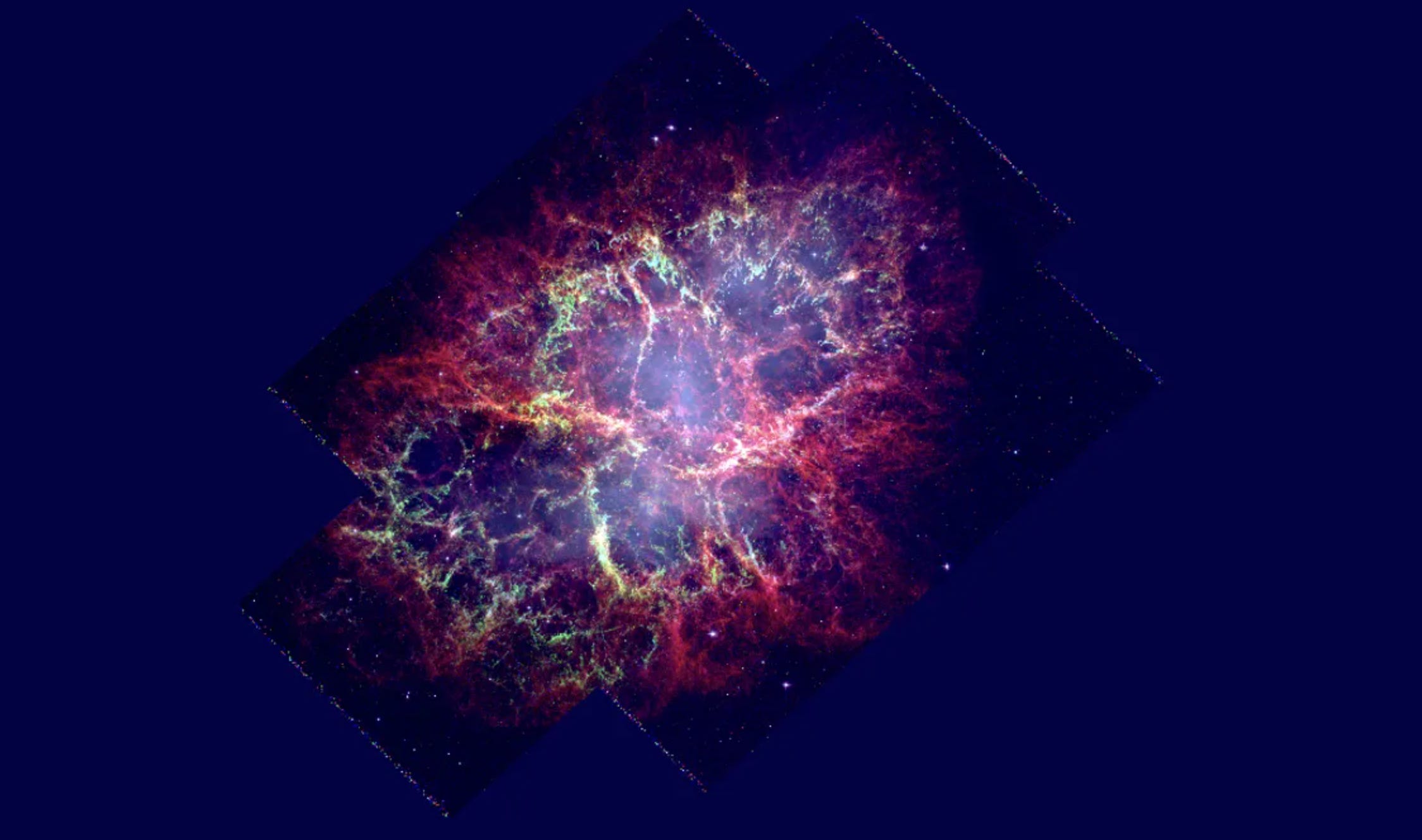
But it’s what’s going on at Taurus’s other horn that’s even more fascinating. There you’ll find a small blurry patch, only visible in telescopes, known as M1. This is the first object in a catalogue of deep space objects such as nebulae, galaxies and clusters listed by the French astronomer Charles Messier, to distinguish them from comets. It is better known as the Crab Nebula, and it came into existence in spectacular fashion.
In July of 1054, early risers would have witnessed a brilliant new star, surpassing all others in brightness, in the horns of Taurus. Yang Weide, the court astronomer of the Song dynasty in China, noted it as a ‘guest star’. Japanese and Arab astronomers also observed it, and there may be a depiction of this new star painted on rocks by Ancestral Puebloan peoples in New Mexico. For 23 days, the star was even visible in daylight, before fading until it disappeared completely.4
In 1731 the astronomer John Bevis first noticed a strange fuzzy object near the star Zeta Tauri. In the 1920s, Edwin Hubble surmised correctly that this object was linked to the brilliant star that appeared in that location in 1054. As it happens, the Crab Nebula was created by the cataclysmic death of a massive star-a supernova. An explosion so bright it outshone the whole galaxy. And as it faded, it left behind a cloud of dust - all the elements that were forged in that star during its life and in the explosion itself. At the nebula’s heart is a neutron star, the husk of a once mighty star reduced to only 30km across, made of material so utterly dense that a matchbox full of this stuff would weigh 3 billion tonnes! It’s also a particular type of neutron star called a pulsar, so called because of how it produces pulses of radiation as it rotates 30 times a second, flashing regularly like a cosmic lighthouse.
And I haven’t even mentioned M45, the Pleiades, the most story-packed star cluster of all. That would make this article twice as long as it is already, below is a link to a previous piece of writing about it. In future I hope to write more about the Seven Sisters. For now, look out for a tangle of blue-white stars, like a tiny version of the Plough, to the right of the Hyades. They are one of the most endearing patterns of stars in the whole sky, and they bloom when you look at them with binoculars (I recommend binoculars rather than a telescope for the Pleiades, as they fill the field of view perfectly. Even birdwatching binocs or opera glasses will do!)

One more thing: for the next few years, Uranus will be passing through Taurus, this year it’s near the Pleiades. The elusive ice giant planet, said to be just about visible to the eye in the darkest of skies, is best found with binoculars or a telescope, the latter will bring out the planet’s blue-green colour.
So if skies are clear, this is the perfect time to look for the heavenly Bull, an ancient and formidable star-speckled beast, one of winter’s finest sights.
Find out more
Listen to the Taurus episodes of Tales of the Night Sky for more on the myths of Europa and the Minotaur.
For an in depth chapter on the discovery of the Crab Nebula, I recommend Giles Sparrow’s A History of the Universe in 21 Stars.
Some have also speculated that a line of dots next to the ‘Taurus’ bull in the same painting represents the stars of Orion’s belt, but there’s a big flaw with that theory - there are four dots painted, and Orion’s belt famously has three stars, not four!
Leendertz, Lia ‘The Almanac, A Seasonal Guide to 2025’, Gaia, 2024, p.99
For the full story of the Pinching Stars, and how to engage respectfully with Navajo astronomical knowledge, read this PDF by Nancy C Maryboy.
Oddly, it seems no conclusive records of this ‘new star’ exist from Europe. This was likely because of religious reasons: in 1054 the Church had undergone the Great Schism, where the Western Catholic Church had cut ties with the Orthodox Church, splitting Christian Europe into east and west. This schism was like an ideological and theological earthquake across the continent, and so took a lot more importance in the writings of the time than the appearance of a strange new star in the sky.