

Lepus the Hare
Bounding away from winter


What the constellation represents: a hare
History: ancient
Region of sky where it is located: equatorial/southern (so just below the celestial equator, a little low in northern latitudes)
When visible? Winter to early spring
How visible? Intermediate
Objects of interest: globular cluster M79, Hind’s Crimson Star
How to see it: Lepus isn’t very bright but is easy to locate because it is directly underneath Orion. Look under the hunter’s ‘legs’ (the stars Saiph and Rigel) to find his ‘prey’. If you join the stars it actually does resemble a hare or rabbit, even with stars representing the ears.
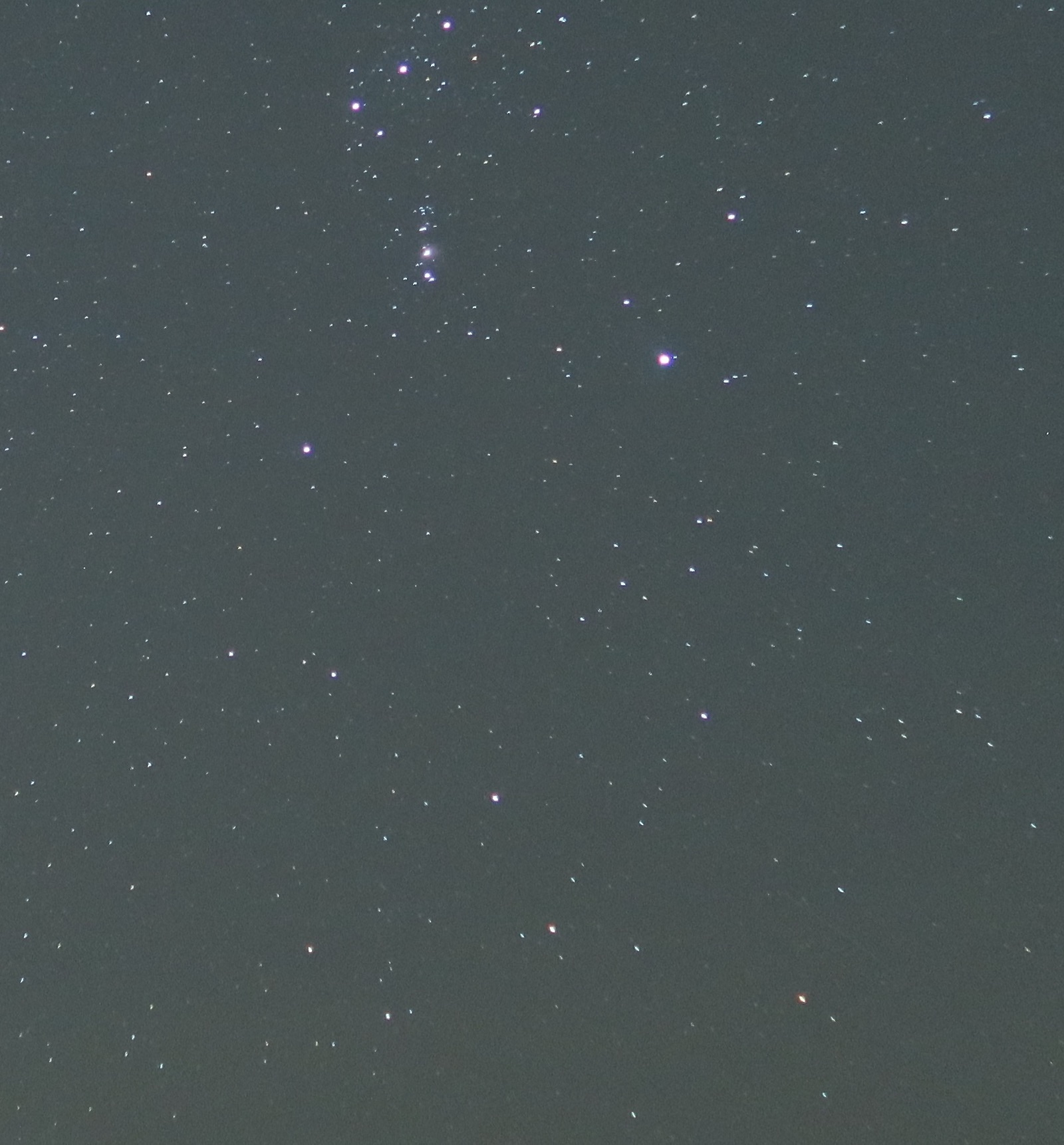
Normally my constellations of the month are chosen based on best visibility, and Lepus is actually more of a winter one. It can be seen on early spring evenings, even if it sets pretty quickly after sundown. But I’ve been thinking about hares a lot. They are the de facto animal associated with March in Britain, and they’ve been popping up in places in my life, from groups I’m in, to receiving a book called Raising Hare by Chloe Dalton in a subscription box along with other hare-themed goodies. I’ve now started reading the book and it is enchanting, in which the author raises an abandoned leveret and learns more about hares, and reconnecting with nature, in the process. It’s been a long time since I’ve seen hares in the wild though. I’ve not been lucky enough to see them boxing, but I have seen them run and that’s when I knew that they weren’t rabbits, and I understood why stories talk of the hare’s speed. Lithe, agile and muscular, they are the athletes of the meadows.
And like real hares, which are pretty much a species that only live in the countryside and don’t seemed to have adapted as easily to urban parks like their cousins, the rabbits, Lepus is a constellation that really needs a dark sky to appreciate the hare-shaped star pattern, right down to the ears. Also it is quite low down so susceptible to being lost in the haze on the horizon, a bit like a hare hiding in the grass.
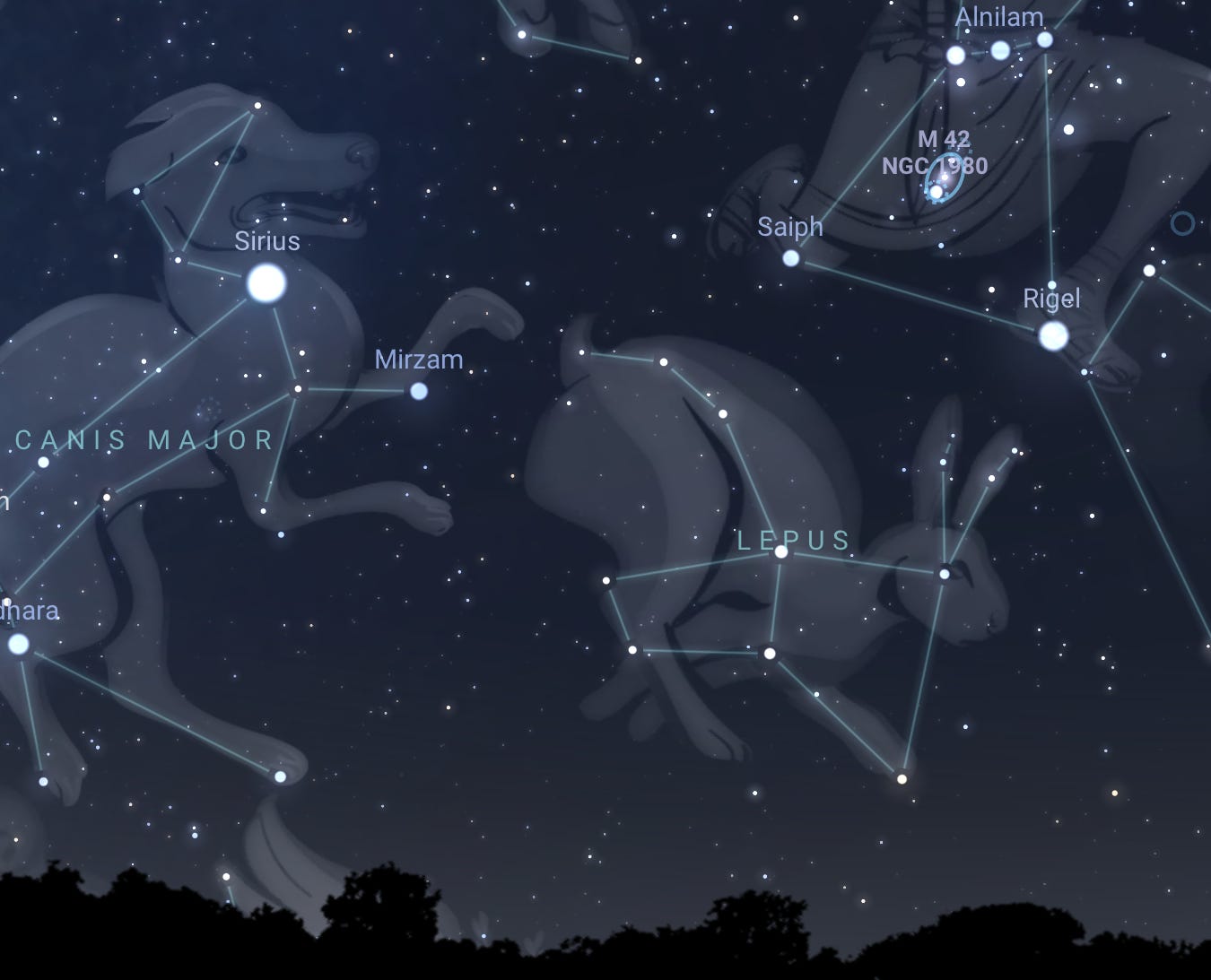
There aren’t any big epic myths for the constellation Lepus in Greek myth, although there are fables and folklore about hares in general. The most common story is that this hare is simply Orion’s hunting quarry, or a hare chased by the hunter’s dog, Canis Major. Some say Orion is trampling the hare, others that he ignores it in favour of more formidable prey such as Taurus, and lets his big dog deal with it. Aratus wrote: ‘Close behind he (Canis Major) rises and as he sets he eyes the setting hare.’ And you can still see this eternal chase across the sky. Another account says that Hermes put the hare in the sky to honour the animal’s swift-footed nature, a quality the messenger of the gods admired.
However, there is another more intriguing myth about Lepus, recounted by the ancient Greek writer Hyginus, and it is a surprisingly prescient environmental tale…
Once, the island of Leros had no hares living on it. But one man, who clearly loved the animals, brought with him a pregnant hare when he moved there. Others followed suit, bringing hares over from the mainland. But then the population got out of control-the hares were breeding profusely and they overran the island, devouring the plants and starving out the local wildlife, but also causing famines for the human population by eating all their grain. So the people removed them from the island, and the image of a hare was placed among the stars as a reminder not to tinker with nature’s equilibrium. It also shows that the introduction of a non-native species to a new environment, to the detriment of that environment, is not a recent phenomenon. And humans have not learned-more than ever, we hear stories about ‘invasive species’1 overrunning ecosystems, outcompeting with the native wildlife, destroying crops. The problem isn’t restricted to animals either-invasive plant species can be just as damaging. And like with the story of Leros, this problem is more acute on islands, which tend to have incredibly unique biodiversity and species found nowhere else in the world, and their delicate balance can be quickly undone with the thoughtless or accidental introduction of new species.
I did wonder if there’s some lost celestial symbolism of the starry hare going into the ground, down to the earth or merging with the day in springtime. In springtime it is tempting to think of it as a starry Easter Bunny!2 What is happening in the stars seems to mirror the behaviour of these animals at this time of year, performing their ‘boxing’ rituals and then giving birth to leverets.
Outside of the stars, hares and rabbits are often associated with the Moon in various places across the world, such as China and Mexico. This may be because at certain latitudes, or at particular times of year or night, the orientation of the Moon in the sky shows not a face (as is common in stories about the Man in the Moon), but the shape of a rabbit formed by the craters and dark basalt plains, known as Mares, on the lunar surface. Hares and rabbits are also crepuscular (up at dawn and dusk), and tend to be more active at night, which could also be another reason for the association with these animals and the Moon.

The hare is a creature that has a lot of stories attached to it. The most well known is the fable of the Tortoise and the Hare, the classic ‘slow and steady wins the race’ moral tale. Another famous hare is the March Hare from Lewis Carroll’s Alice’s Adventures in Wonderland. Attitudes to hares in folklore are ambivalent. Sometimes they admired for their swiftness and energy. At other times they seen as animals that brought misfortune, and often associated with witches, either as a witch’s familiar or magical companion, or as a witch who has transformed into a hare. They are seen as magical creatures that could be used to foretell and bring foreboding. Boudicca was said to have used a hare for divination, looking for signs of a victory against the Romans. And in Cornwall, there’s the legend of a ghostly white hare that was said to run through the harbours at dusk, its appearance supposedly a sign of a coming storm.
Hares have an intriguing biological quirk that may have inspired people across history to associate them with fertility, magic and miracles. Rabbits are of course well known for reproducing like, well, rabbits. Hence the obvious fertility associations there. But hares can do something more unusual-the females can give birth to leverets while being pregnant at the same time. In ancient Greece, Herodotus and Aristotle noticed this, the first documentation of a phenomenon called superfetation, which means that the hare can be pregnant with two litters at once. This gave the hare associations with lust and promiscuity. The supposed ability of hares to self-conceive meant that they were also sometimes linked to the Virgin Mary and chastity-a complete contradiction to this animal’s more profane associations and superstitions. In addition, hares were associated with madness, thanks to their behaviour of boxing in the fields (thought to be a form of courtship, or females fending off males). This is just a small amount of the wide variety of hare folklore, which is widespread across the world, and gloriously contradictory-clearly us humans have been intrigued by this speedy and secretive creature enough to place it in the heavens!
As for stellar folklore from other cultures, there wasn’t much else I could find (if I had more time I’d go a little deeper on the research here-but this month has been busy!) but it seems the Arabs borrowed the Greek constellation, and named its main star Arneb (simply meaning ‘hare’). I did find a rather…different take on this constellation from China. There, the stars of Lepus represent a toilet, with some stars representing droppings, of all things! It seems so odd to our Western sentiments to have a constellation representing something so, well, ordinary and possibly a little less refined or grandiose in the sky than the usual heroes and cosmic animals, but hey, toilets are very important, and if you gotta go, you gotta go, even if you are in the stars!
Hurry if you want to catch Lepus in the sky, as it will fade into the evening twilight along with Orion and his dogs. Alternatively, wait until the winter months for a better view. In this case, I like to think of a wintry version of the hare, so maybe less of a Brown Hare, and more of a Mountain Hare, a species that changes its coat in winter from grey to snowy white. Both of these hares found in the UK are threatened or endangered, from habitat loss, intensive agriculture, uncontrolled hunting, and climate change. I would encourage you to read more about hares or see if you can find them in your area if you live somewhere where they are present. You can also research the hares found in your country or region-I have just mentioned British hares but there are many species of them found all over the world, and they have their own stories. There is much more to say about these fascinating animals, I have only just touched upon the strange and wonderful stories of hares through the perspective of one constellation.
And when out stargazing, for the rest of this month speeding by, see if you can spot Lepus before he leaps away.

Sources and further reading
Raising Hare by Chloe Dalton, Canongate, 2024
Constellations by Govert Schilling, Hachette, 2019
Ian Ridpath’s Star Tales: Lepus
Hare Mythology from The Field magazine
I am aware that the term ‘invasive species’ can be seen as controversial. I usually favour the term ‘introduced species’ as not all non-native species have such a destructive effect on their new habitat, and can become naturalised. Even the brown hare, often considered to an ‘classic’ British animal, was brought over from mainland Europe by the Romans.
The link between Easter and hares/rabbits will take you down a very twisty rabbit hole-pun intended. In short, Eostre, the Germanic goddess from whom the festival of Easter was supposedly named, is said to be linked to rabbits or hares. However, the oldest mention of Eostre comes from only one source-the Venerable Bede, the early medieval English monk and historian, and some wonder if Eostre the goddess even existed or if Bede made her up! The association with rabbits and hares and this goddess came much later, thanks to the German documenters of folktales, the Brothers Grimm. There’s a lot more complexity to this if you want to really get into it…
A great read. We are fortunate to have a healthy population of hare's around us and can sometimes see 16 in the same field behind home. I shall be sure to look up now though also.
As you are on a hare theme you might like to watch this short video.
https://youtu.be/eTLpUrX2GQw?si=TEE4ZOxV_KEACYJZ