

5. Leo
The mighty lion


Symbol: ♌️
What the constellation represents: a lion
Region of sky where it is located: northern hemisphere
When visible: December-June
How visible: very easy
Objects of interest: bright star Regulus, the Leo Triplet of galaxies
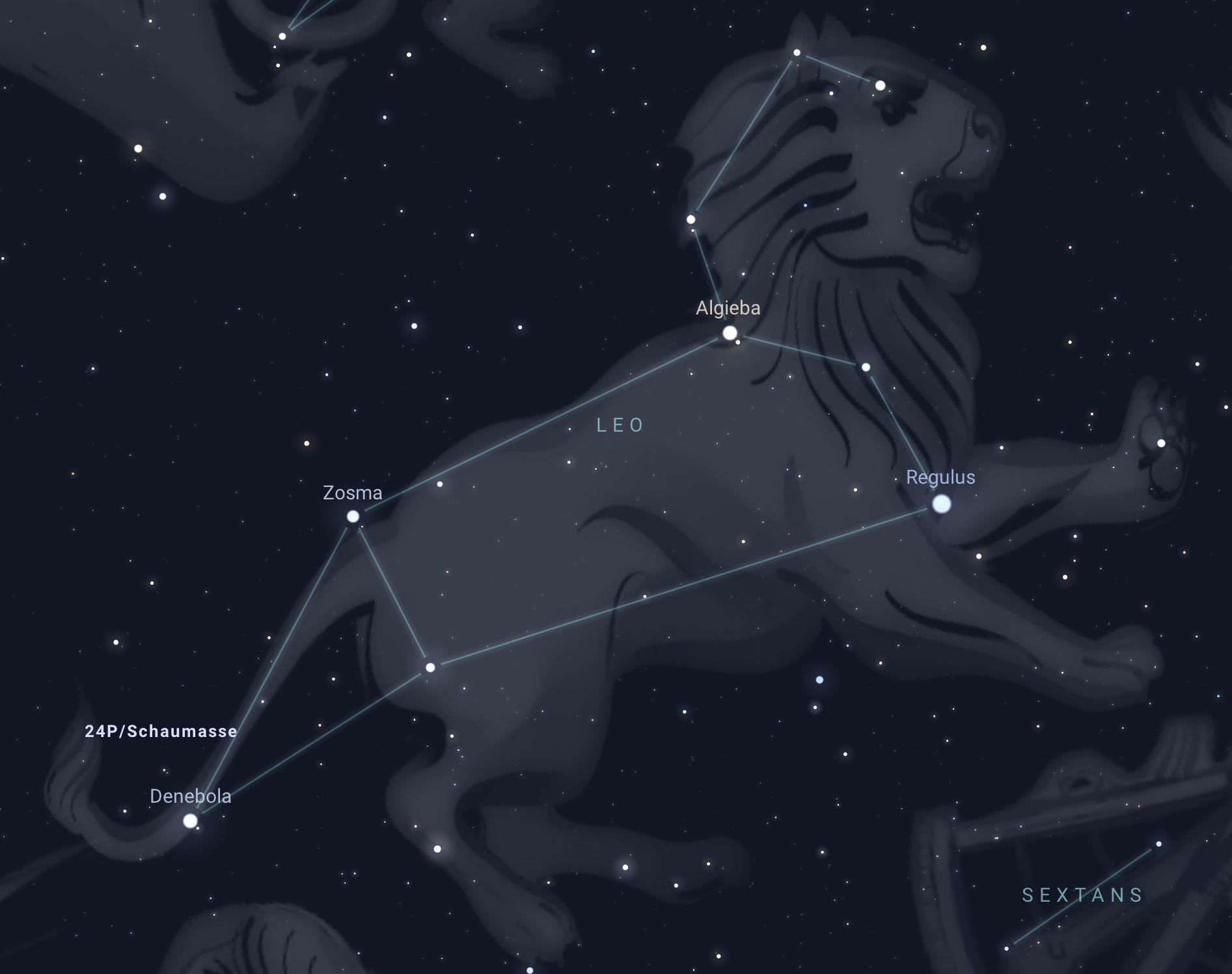
How to see it: the dominant constellation of spring skies, this group of stars has a definite animal appearance. Whether you see it as a lion, a cat-loaf, a duck, or even a giant mouse with a curling tail, is up to you! But you’ll easily notice a backwards question mark of stars followed by a broad, wedge shaped body, these are the lion’s head and torso. It’s not difficult to see it even in suburban skies. To help you find it, look underneath the very well known Plough asterism of Ursa Major for the curling pattern of stars known as the Sickle of Leo.
“Wrong will be right, when Aslan comes in sight,
At the sound of his roar, sorrows will be no more,
When he bares his teeth, winter meets its death,
And when he shakes his mane, we shall have spring again.”
-CS Lewis, The Lion, The Witch and The Wardrobe
Seeing the majestic form of Leo is a promise of warmer weather in deepest winter. The great starry lion pounces out of the eastern horizon, his head, back, tail and legs glittering, with a bright diamond marking his heart. You might be reminded of the Lion King when you see this constellation, particularly the scene when Mufasa’s spirit appears before Simba. I think of Leo as Aslan in The Lion, The Witch and the Wardrobe, who roars away winter and brings spring on his paws. This is because the best time to see it is in March and April. Some say the phrase ‘In like a Lion, Out like a Lamb’ refers not to changeable March weather, but rather to the constellation Leo rising in the sky, and the Sun moving into Aries at the spring equinox. Another phrase one can use to remember seasonal star patterns is ‘Out with Orion, In with the Lion’ which refers to a changing of the guards between the winter and spring constellations, or perhaps winter’s mighty hunter being chased off by the king of beasts! And Leo isn’t the only large animal you’ll find in spring skies. Above him is Ursa Major, the Great Bear, and below him slithers the snaky Hydra.
One of the most dazzling constellations of the zodiac, Leo resembles a prowling lion or a crouching sphinx (or a cat in a ‘loaf’ position as I’ve seen it described!) and can be easily found in the east at about 10pm in December and early January, and at sunset come late February. The lion’s head is formed of a hook of stars, ending at the bright star Regulus.
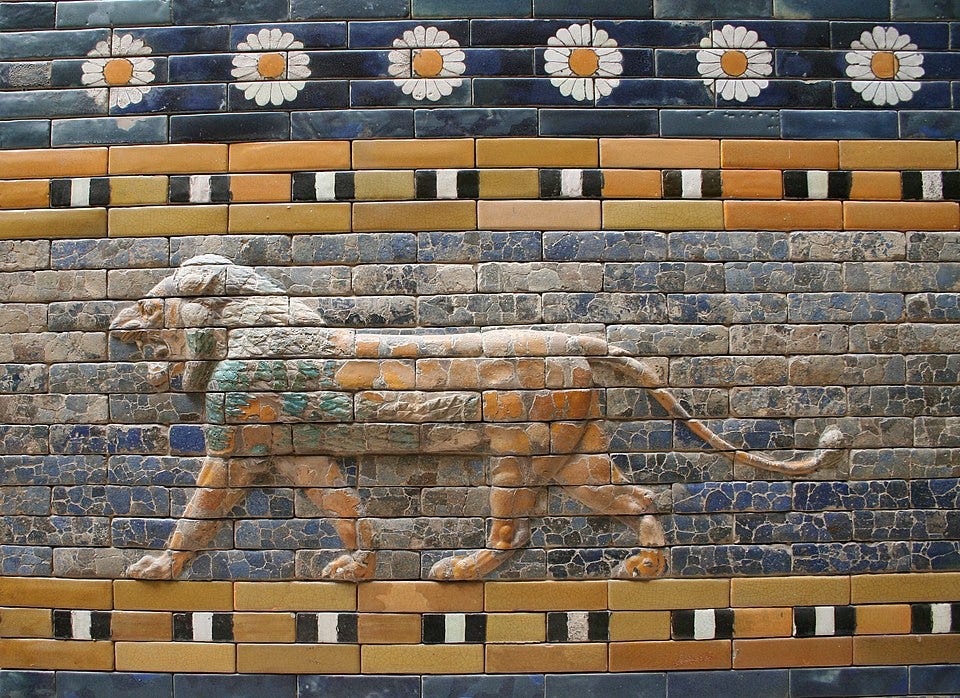
The lion in the stars goes back a very long time, to the Babylonians, Indians, Persians, Egyptians, Syrians and Hebrews, as well as the Greeks and Romans.
In Mesopotamia, the Lion constellation was first recognised around 4000 BCE, in artworks depicting lions alongside bulls and scorpions. This cements the idea that the Lion shown in artwork was astronomical, as the Bull and Scorpion are also zodiacal constellations, and seasonal markers.
To the Babylonians, Leo was called Ur.Gu.La, the Great Lion, a symbol of royalty, and may also have been Humbaba, a monster with a lion’s face and one of the creatures that Gilgamesh encountered and vanquished. The star Regulus was seen as the most important in the constellation, known as there as the King Star, which fits very well with the lion as an animal that to this day has regal connotations. In Babylonian astrology, any omens relating to this star, and the Lion as a whole, was said to affect the king.
From the earliest times, Leo was a symbol of summer at its brightest and fiercest, because the Sun moves into this constellation in the summer months. Thousands of years ago it was the location of summer solstice, the time of greatest light, this was one reason why astrologers linked the sign of Leo to the Sun, along with the solar symbolism of the lion’s golden coat and mane. Then it became the constellation associated with later summer, the period of the year after solstice when the heat becomes stronger and deadlier. In ancient Egypt, the lioness goddess Sekhmet was associated with the ferocious aspects of the Sun, including drought and pestilence. One myth tells of her being sent by the sun god Ra to slaughtering people as punishment for their misdeeds, and she became overcome by her bloodlust and couldn’t stop killing. So the people took great jars of beer and dyed it red, and gave it to Sekhmet as an appeasement. Thinking the jars were full of blood, she gulped the beer down, and collapsed in a drunken state. The goddess woke up with a headache, but her raging temper had calmed. The Egyptians feared Sekhmet and her capability for causing destruction, but they also respected her for her warrior strength and healing powers, erecting plenty of statues of her to keep her sweet.
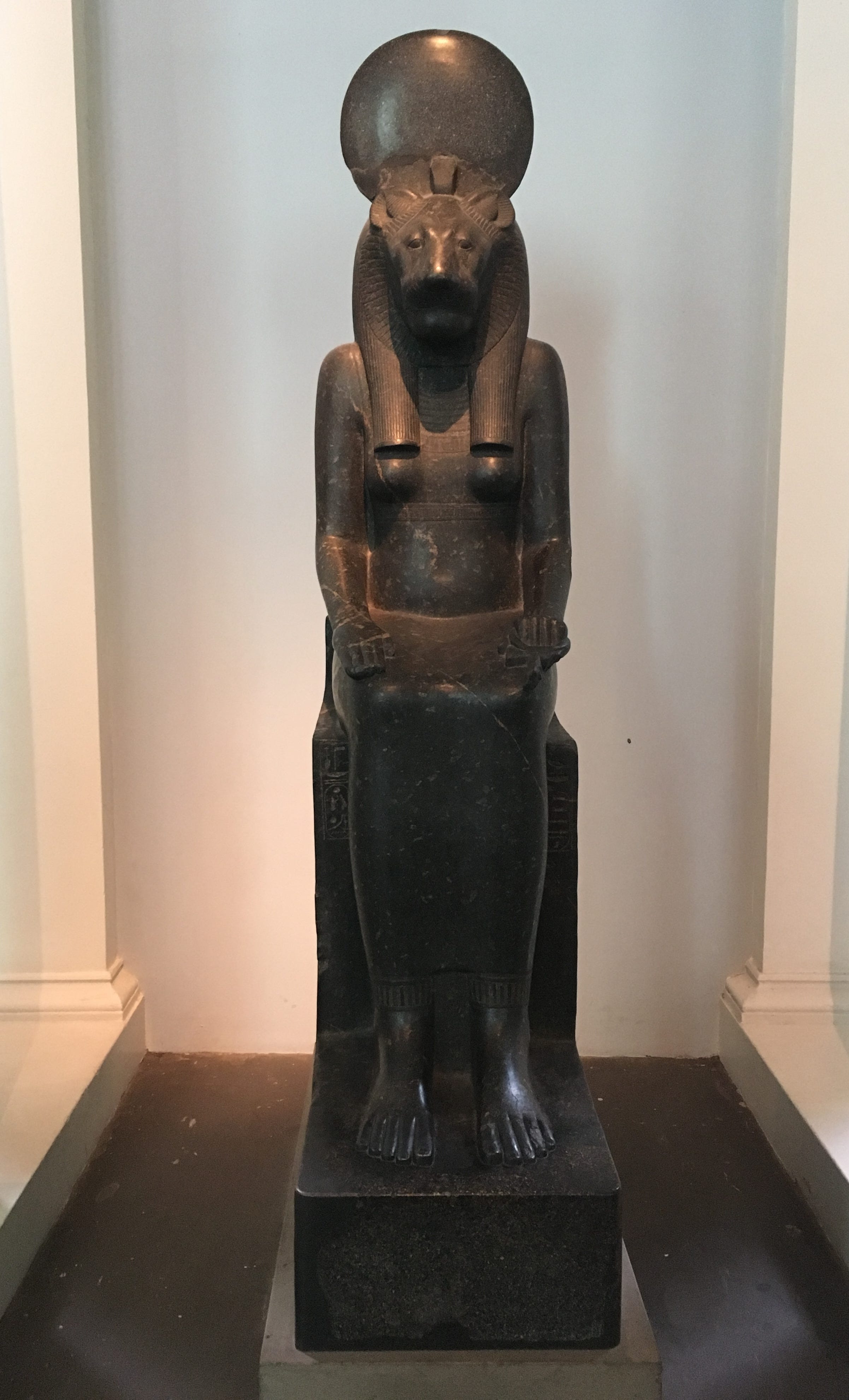
In Egypt Leo features in the Dendera Zodiac, a depiction of the night sky blending Egyptian and Greek influences. The historian Plutarch, who travelled to Egypt, said that the Nile flooded during the time when the Sun was in Leo, and lions would gather around the river to drink its waters during sweltering summer days.
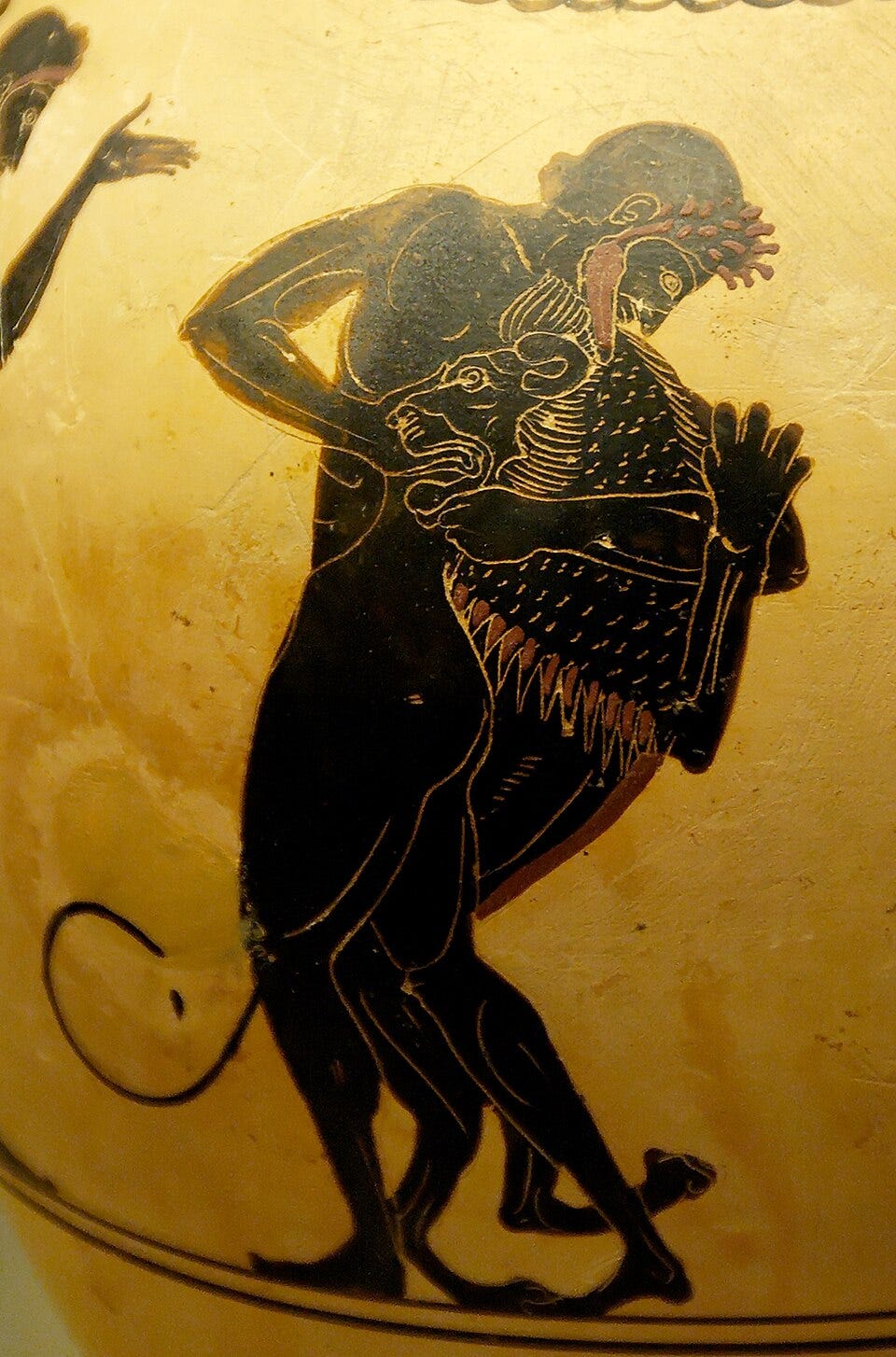
According to the Greeks, one account said that the gods put the lion in the sky simply because it was perceived as the king of beasts, the top predator and the most formidable of animals. But a more famous Greek myth has Leo as the Nemean Lion, one of the creatures Heracles was sent to slay as part of his twelve labours.
This monstrous lion, said to be the child of the Moon in some accounts, or the offspring of the monstrous Typhon and Echidna, had a golden hide that was impervious to all weapons, no blade could pierce it. The beast prowled the land, kidnapping people - particularly women - and once they were taken to its cave, the lion devoured them. Many brave warriors tried to kill the lion, only to get eaten themselves. But Heracles was told that this would be one of his twelve arduous challenges - to kill the lion and bring back the hide as proof of his success. So he went to Nemea and crept into the lion’s cave when the beast was sleeping. Suddenly, the lion awoke and lunged at Heracles. But the hero, with his awesome strength, grabbed the monster, pinned it down and strangled it with his bare hands, until it was completely lifeless. Once it was dead, he removed the hide using the lion’s own claws, and from then on, Heracles wore the pelt of the lion as a trophy, and it had the added effect of making him invincible. The gods then honoured the beast by placing it in the constellations.
The sickle asterism found within Leo is an old one too. In Mesopotamia it was called the Gis-Mes, or Curved Weapon, a sharp blade that was either used in battle or as an agricultural tool. The Leo constellation we know today first comprised this shape and the star Regulus, before expanding into the full lion’s body. The asterism was also noted by Central Asian peoples who called it a curved scimitar, and the Celts called it Corran, a blade used to cut the sacred mistletoe growing on oaks. The Roman historian Pliny called this pattern of stars a sickle used to cut the ripening grain, knowing that the Sun would be in the Sickle of Leo asterism around the time the crops were ready to be reaped. In the Wheel of the Year, the festival of Lammas falls during the Leo season, and is the time of the grain harvest, when fields turn as golden as a lion’s coat.
Prior to them importing constellations from the Greeks, the Arabs also had their own lion constellation called Al-asad, and it was made up of stars in Leo. However, Al-asad was a lot bigger than Leo, encompassing a wide slice of night sky, including stars from Gemini, Virgo, Cancer, Canis Minor, Bootes and Ursa Major. This gigantic constellation was an important seasonal indicator that was used to foretell summer heat and the eventual quenching rains that followed, determined by which of its stars was setting in pre-dawn hours.
In Chinese astronomy, the front part of Leo, including the Sickle as well as other stars, form a constellation called Xuanyuan, the Yellow Dragon. This was the spirit of the Yellow Emperor, the mythical founder of Chinese civilisation. Other stars and asterisms within Leo represented the court of this legendary emperor, including is crown prince, bodyguard and personal assistant.
In North America, the Ojibwe and Anishinabe people also see a big cat in the stars of Leo, along with neighbouring Hydra. This is Mishi Bizhiw, the Curly Tail of the Great Panther, a dangerous water spirit associated with floods and drowning. The sighting of this constellation signalled the thawing of winter’s ice, and marked the time to move from winter camps to the sugar bush camp.
Leo in depth
The brightest star in the constellation is the diamond white Regulus, which means ‘little king’ in Latin. This is a translation of the earlier Greek name, Basilikos. It is also known as the Lion’s Heart (Cor Leonis in Latin, Qalb-al-asad in Arabic), and Mesopotamian peoples were the first to give it a royal association, naming it as Lugal, meaning ‘king’. It is located very close to the ecliptic, meaning the Moon and planets get close to it and even occult it. Like Aldebaran, this star was also considered a ‘royal star’ marking summer.
Some astronomers think that 2000 years ago there was a conjunction of Jupiter and Saturn, or Jupiter and Venus next to Regulus, and this was the ‘Star of Bethlehem’. The Magi were said to be astrologers, so signs like this in the sky would have been seen as very auspicious. According to this theory, the conjunction was special because Jupiter was the king of the gods, Venus represented the divine feminine, and Regulus was astrologically linked to royalty and leadership. So a combination of all these symbolised a kingly child born to a mother chosen by God.
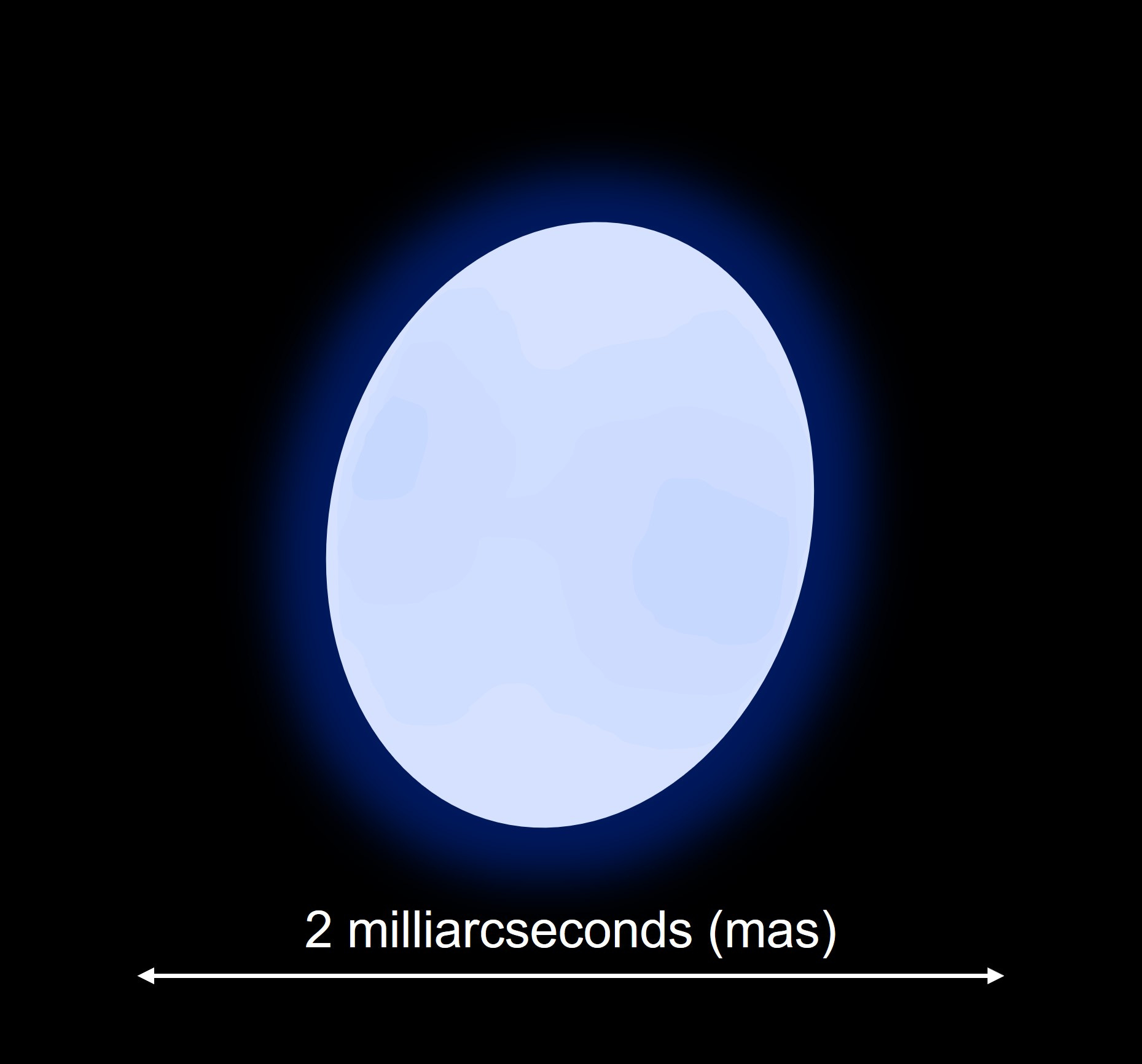
Like a king attending to his court, the star we see as Regulus is orbited by three other, less bright stars. The main star, the hot, white Regulus A, spins so fast that it flattens into a shape like a rugby ball. If it spun any faster it would tear itself apart. Around it orbits a pair of stars, one is orange and the other is a red dwarf. The fourth companion is a white dwarf - the glowing corpse of a Sun-like star that ended its nuclear fusion process, and has now shrunk into a small and very dense body similar in size to the Earth. All the stars in the Regulus system are 79 light years away.
Denebola, marking the lion’s tail, is the second brightest star in the constellation, and can be found at the other end from Regulus. (The word Deneb is common in star names, as the Arabic word for ‘tail’.) According to early Arabic folklore, this was a star that signalled a change of weather, depending on whether it was rising at dawn (foretelling winter) or setting at dawn (signalling the summer heat). In Chinese astronomy this was Huangdi, the Yellow Emperor’s star. Denebola is 36 light years distant, a white star that’s 18 times more luminous than the Sun.
Algieba, located in the lion’s head, means ‘forehead’ in Arabic, is a double star that splits into two golden stars, looking like the eyes of a lion, when viewed in telescopes. Located in the curve of the Sickle asterism, this is where the Leonid meteor shower’s radiant is located (more on that below).
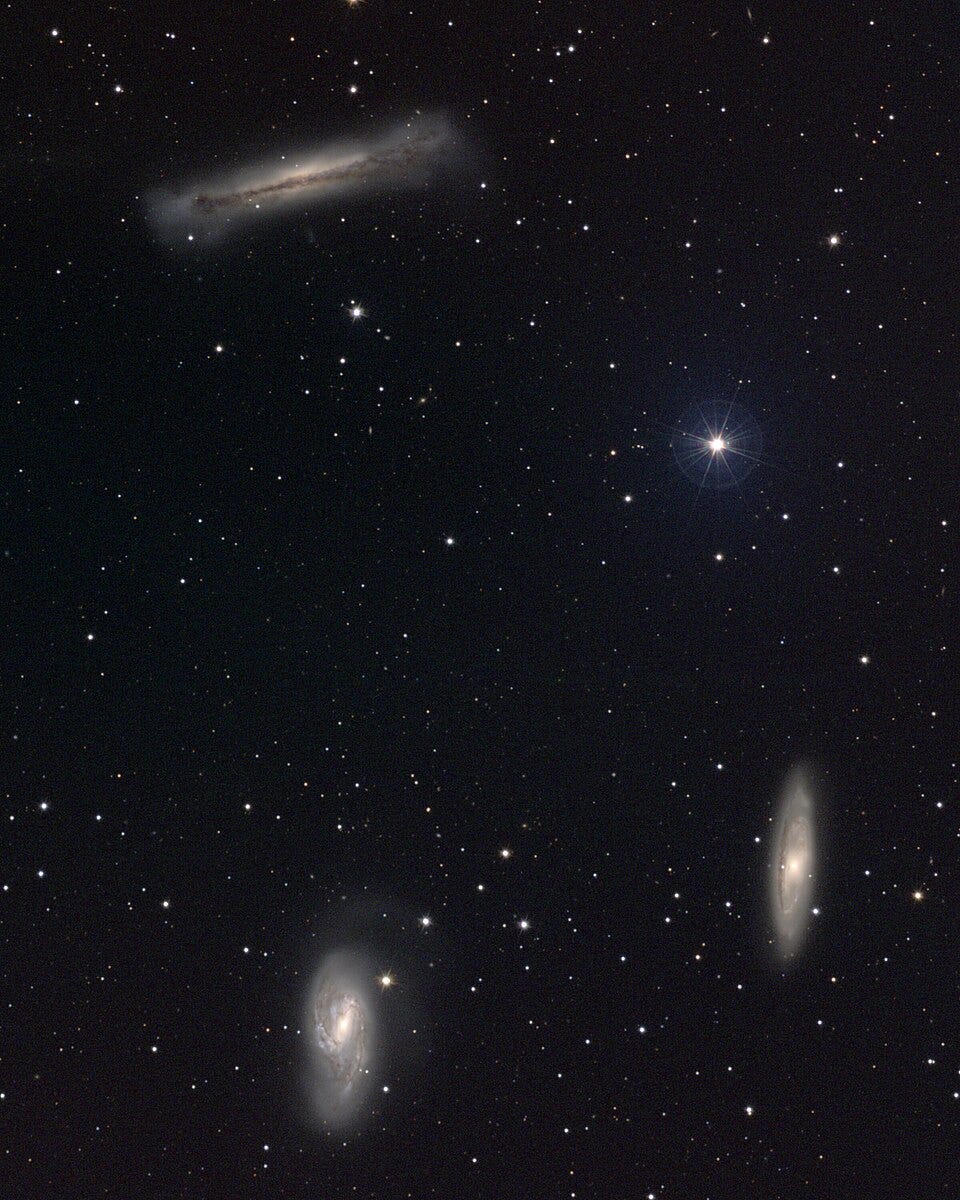
Leo is also a constellation rich in galaxies, beautiful spirals made of billions of stars similar to our own Milky Way. The most well known, sought after by astronomers each spring, is the Leo Triplet, located where the lion’s back legs would be. They are M65, M66 and NGC 3628. Of these, the NGC one is the most distinctive. This is a spiral galaxy viewed from the side, and this perspective gives it is nickname of the Hamburger Galaxy. Observe it and you’ll notice it does look like a galactic sandwich, but instead of a meaty filling, there’s a dark band of dust intersecting the galaxy’s arms.
Near the Hamburger are the two galaxies first spotted by Charles Messier, hence their ‘M’ designations. These spirals are more open and appear like swirly ovals of stars. The three galaxies are not exactly gravitationally bound, but in the past they might have been close enough to interact with each other.
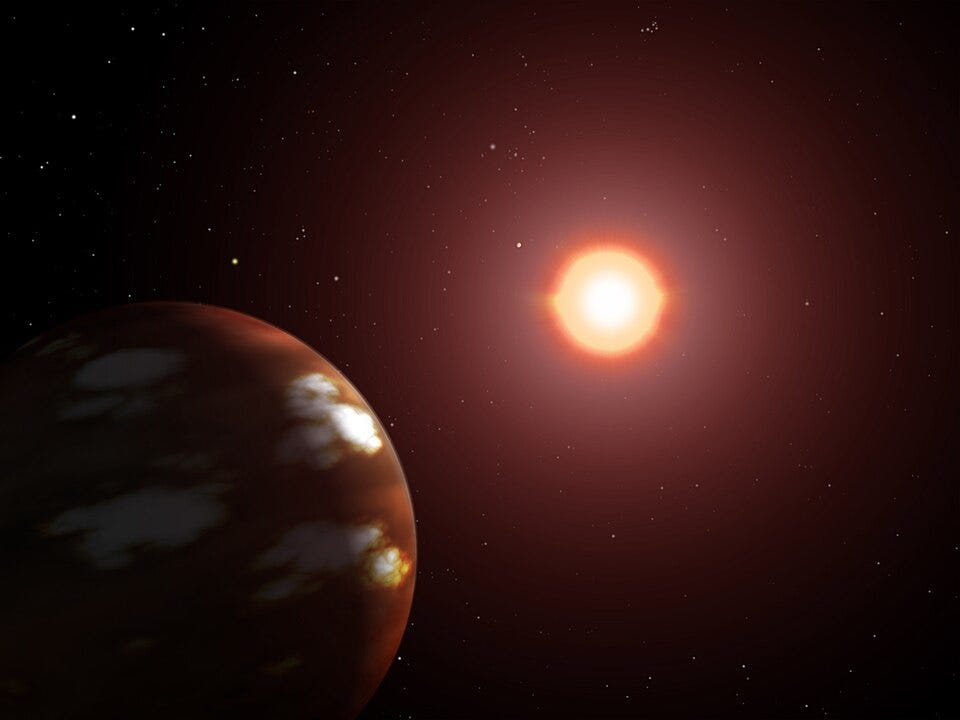
I’ve mentioned some exoplanets in previous zodiac features, and the one I’ve chosen for Leo is particularly odd. Imagine you’re in a spaceship, and you land on a frozen world, a glittering winter wonderland of glaciers and mountains made entirely of ice, glimmering in the red light of the planet’s sun. You exit the spaceship, expecting the cold to hit, even through your spacesuit…only to feel heat. Burning, stifling heat, hotter than an oven. Welcome to Gliese 436b. Termed a ‘hot Neptune’, it is 4 times bigger than the Earth and orbits its red dwarf star in under three days, meaning it is very close to the star. What makes it strange is that, despite its daytime temperature of 390C, hotter than the melting point of lead, it is thought to have a surface made of solid water ice! How, I’m sure you’re asking, could ice survive such temperatures? Well, this is an unusual form of ice, quite unlike the familiar type on Earth, and this weird ice only forms under extreme pressures. The planet’s large size and subsequent gravity would be enough to pressurise water into a bizarre kind of heatproof ‘hot ice’ that forms the planet’s crust. Similar forms of exotic ice can be found on planets like Uranus and Neptune, but Gliese 436b’s ice is subject to intense temperatures, and doesn’t melt, thanks to the shape of the crystals that comprise this frozen substance. Not only that, but the planet’s hydrogen atmosphere is boiling away, trailing far into space like a comet’s tail.1
Every November, the Leonids meteor shower issues forth from an area close to the lion’s mouth, as though Leo is spitting out shooting stars. Most years, this shower is actually quite a sparse one, only producing a few meteors per hour. But there are some years when the lion really roars. In 1833, the Leonids produced a meteor storm so impressive, it was as though the sky was raining stars. Meteors in their thousands streaked across the sky every second, the whole sky filled with shooting stars, startling everyone who witnessed them, some even thought the sky was falling and the world was about to end! Imagine what a sight that would be! Further Leonid storms occurred in 1966 (when for 20 minutes, 2500 meteors were seen per minute) and in 2002. These outbursts of meteors occur every 33 years, and coincide with the close approach of the shower’s parent comet, Tempel Tuttle, to the Sun. This causes the comet to shed a lot more dust than usual, the Earth then travels through this cometary debris, and we get a natural firework display as a result.
So if winter is getting you down, let the Lion reassure you that when he rises, warmer weather cannot be far behind.
Find out more
More on the Arabic Lion constellation
Wikinews on Gliese 436 b’s ‘hot ice’
This was one of the planets I studied in my MSc!