

4. Cancer
The cosmic crab


Symbol: ♋️
What the constellation represents: a crab
Region of sky where it is located: northern hemisphere
When visible: December-May
How visible: advanced
Objects of interest: the Beehive Cluster, 55 Cancri
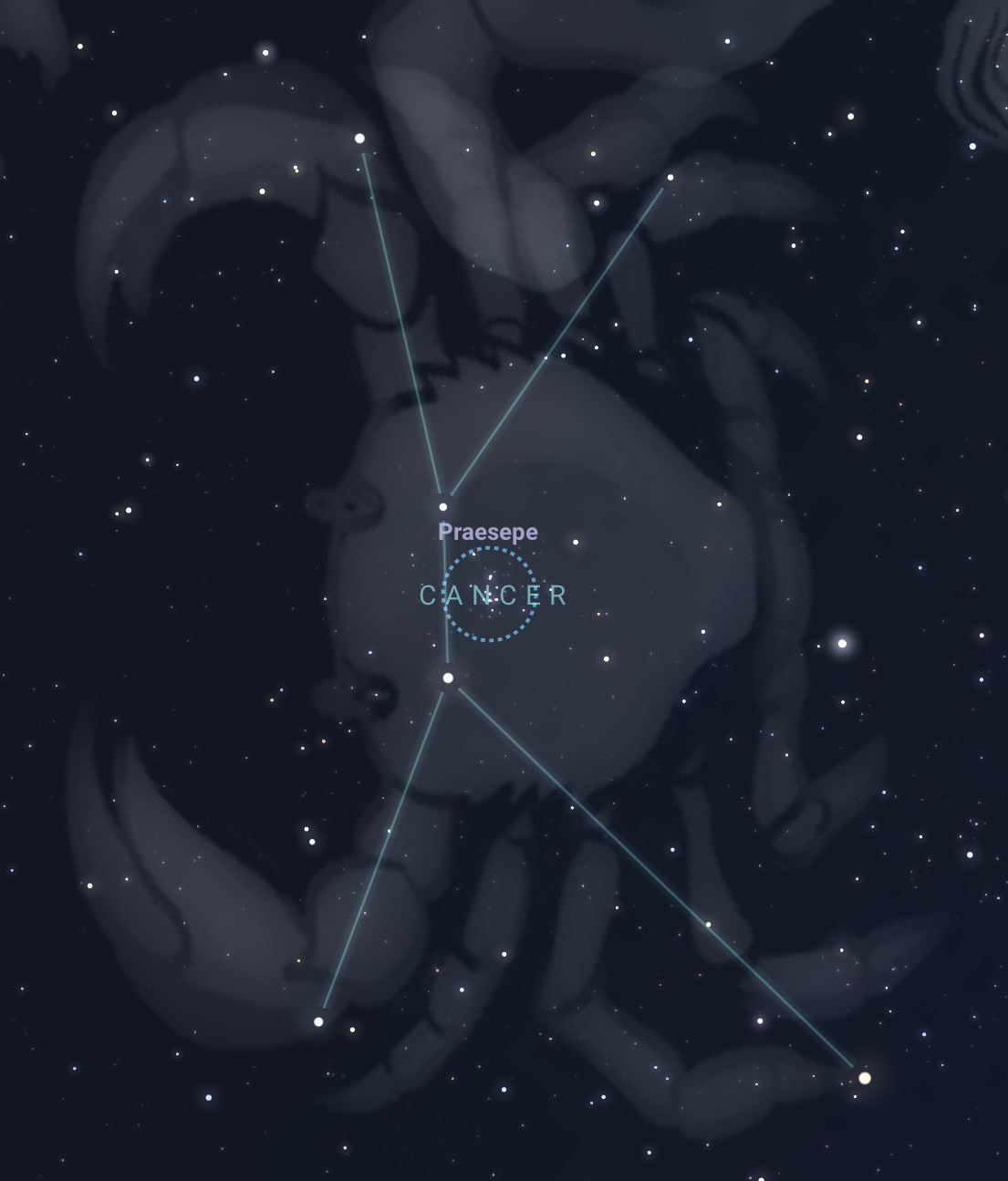
How to see it: this constellation is one of the most challenging to find! Its faint stars require a very dark sky for naked eye observation. To find the crab, look for the Gemini twins, and then look eastwards. To the east is another bright star, Regulus, the heart of Leo the mighty lion, which looks like a ‘sickle’ shape of stars rising. Between Leo and Gemini is where Cancer is located.
Of all the zodiac constellations, Cancer the crab is the trickiest one to see, hiding in the darkness like a hermit crab, so dim are its stars. But within the crab’s body is a treasure of the night sky, a cluster of stars huddled tight like a swarm of insects. One could imagine this as a mother crab, and the cluster as eggs on her shell. But first, let’s discuss the celestial crustacean as a whole, a constellation long associated with animals that live in water and/or have hard shells or exoskeletons. And it has a special place in the zodiac as the ancient guardian of the June solstice point.
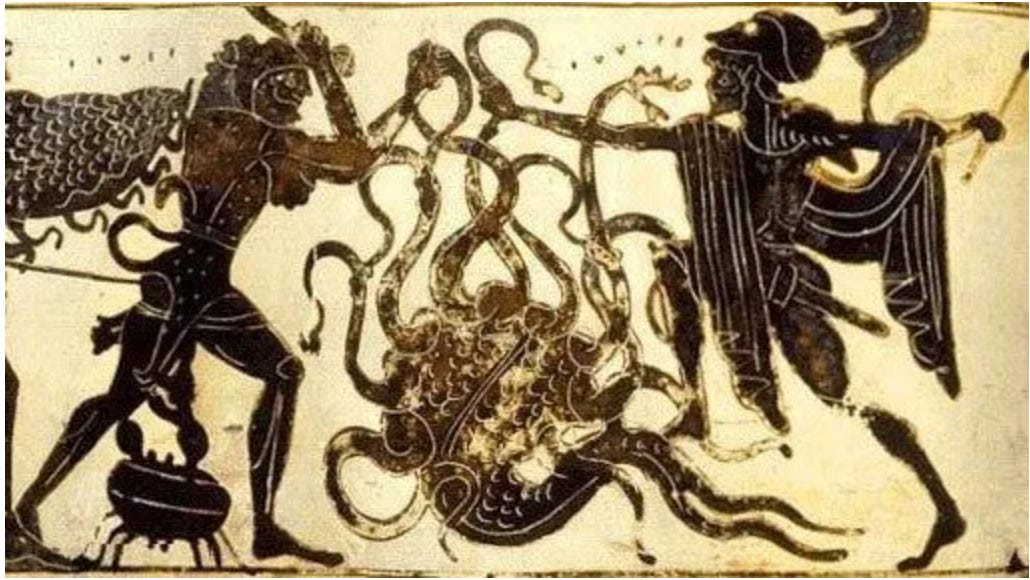
To the Greeks, Cancer was Karkinos, a crab that the goddess Hera, wife of Zeus, sent to distract Heracles as he battled the Hydra. In the swamps of Lerna, this terrifying many-headed snake creature roamed, and one of Heracles’s tasks was to kill the monster. A challenge because every time one head was cut off, more grew in its place. Hera hated Heracles, as he was the son of Zeus from another woman, and she thought she’d make his labour a bit more difficult, by sending a crab to get in his way. The crustacean nipped and pinched Heracles on the foot as he tried to slay the Hydra, and the hero was so annoyed by the little creature that he crushed it underfoot. Crunch. Hera had a soft spot for the crab and its steadfast determination, so she elevated it into the stars and placed it somewhere rather special…
For such a minor character in the myth, Cancer the crab was given an elevated position at the very height of the ecliptic, where the Sun reached its most northerly declination on the June solstice, the longest day of the year. This part of the sky was once believed to be the portal where souls entered the world before being incarnated into mortal humans. You will have heard of the Tropic of Cancer, the geographical line that marks where the noon sun can be seen directly overhead during the northern hemisphere summer solstice. This line encircles the globe 23.5 degrees from the equator, and of course this is the same as the degree of the tilt of the Earth’s axis. Like the earthly equator, the tropic of Cancer is projected into the sky as well, and passes through the crab constellation, or at least used to. The June solstice point is now on the Gemini-Taurus border thanks to our friend precession, but like with the first point of Aries, the old name has remained.
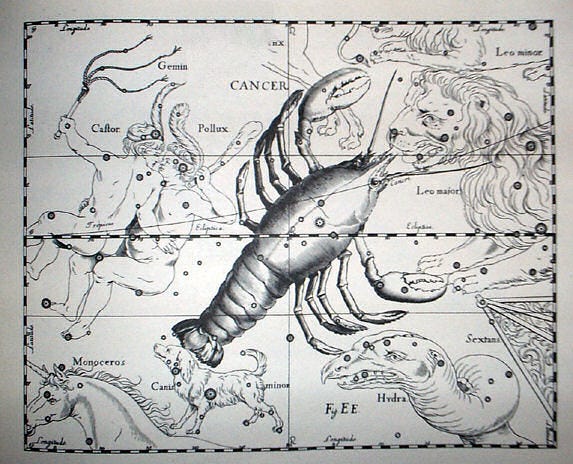
The Babylonians first called Cancer Alla, or Mul.Al.Lul, the ‘deceptive digger’, often interpreted as a crab, and it marked the ‘northern gate of the sun’ ie, the summer solstice point, and the realm of the sky god Anu. The constellation was also seen as a turtle or tortoise. It has been suggested that these animals, known for walking sideways (the crab) or slowly (the tortoise), were associated with the constellation due to the way the Sun appears to move at summer solstice - seemingly slowing down in its overall northward journey and changing its path to a more southerly declination. In later star maps, Cancer was also depicted as another crustacean, such as a lobster or a crayfish.
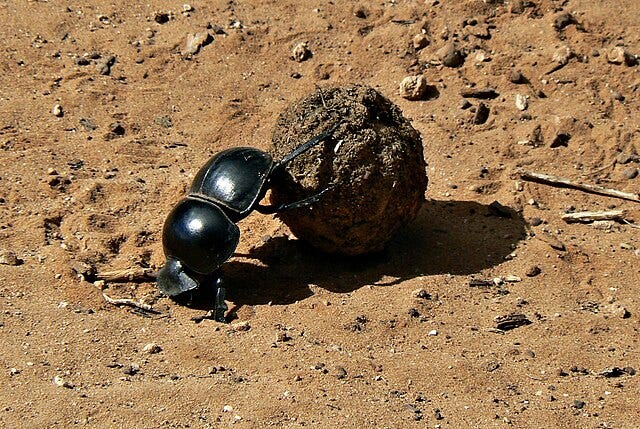
This association with the summer solstice may be why in ancient Egypt, Cancer was the scarab god Khephri. This is the divine dung beetle that rolled the sun across the sky. Every morning this insect would pick up the ball of the sun and push it through the heavens, east to west. The Egyptians revered these beetles, and their image was made into scarab amulets placed on the hearts of the mummified dead. This would protect the deceased on their journeys through the underworld, inscribed with spells to ensure the heart would utter pure words and allow access to the blessed afterlife. But there’s something else that’s amazing about dung beetles, which further cements their place as an ‘insect of the gods’ in my mind: they navigate using the Milky Way. Scientists have wondered how they move in straight lines at night, and so researchers placed beetles in planetariums. When they projected an image of the Milky Way onto the planetarium, the dung beetles moved according to its orientation. This is remarkable for a creature that doesn’t have the greatest night vision, and yet it can detect this great arch of our galaxy with its light sensitive cells and use it to find the way. Unsurprisingly, the researchers also confirmed that light pollution is having a detrimental effect on dung beetle navigation. By blocking out the Milky Way in the planetarium similar to the effect of an overly lit night sky, the beetles were seen to move in more random paths. These insects show us that the most unexpected animals have complex celestial navigation tricks that we’re only just finding out, and also how light pollution is so detrimental for their survival.
Cancer in depth
The alpha star of Cancer is called Acubens, from the Arabic al-zubanah meaning ‘claws’, and it marks one of the pincers of the crab. It’s faint, but it’s whiter, hotter and slightly more massive than the Sun. It is 188 light years away, so we see the light that left it in 1837, the beginning of the the Victorian era.
Cancer is one of the smallest constellations in the zodiac, but at its heart is a gorgeous open cluster of stars. The celebrated Pleiades get all the attention and are easier to see. But if you are in a very dark area, far from any lights, and there is no Moon, you will see a ghostly smudge of light within Cancer. This is M44, commonly called the Beehive cluster, probably because it resembles either a beehive or a swarm of bees. It might also take this name from the cluster’s other name, Praesepe, a Latin term for hive that also translates as ‘manger’. During the festive period it seems ever more fitting, there are even two stars next to it called the Donkeys. And this starry manger with attendant donkeys pre-dates Christianity. It was first associated with Dionysus, god of wine, and the donkeys he and his friend rode during the battle of the gods and the titans. Their braying was so loud and frightening to the titans that they ran off, thinking a monster was making that noise. Dionysus placed the donkeys in the sky next to the nebulous fuzz, which could be seen as a pile of hay. Later Christian folklore associated these stars with the manger of the Nativity, which fits with the cluster rising at nightfall around Christmas time.
The Chinese called the stars surrounding the Beehive Gui, or Ghosts, and the cluster itself was called Jishi, or Tshih She Ke, meaning ‘exhalation of piled up corpses’. Another name for these stars is the Ghost Wagon, sometimes depicted as a demon in a carriage. Though the Chinese also gave this spooky-seeming cluster a more romantic description as a ‘cloud of pollen blown from willow catkins’.
To the Arabs, the fuzzy cloud was called An-Nathra, meaning the Sneeze of the Lion. Their Lion constellation contained the stars of Leo, but was a lot bigger and encompassed stars in neighbouring constellations.
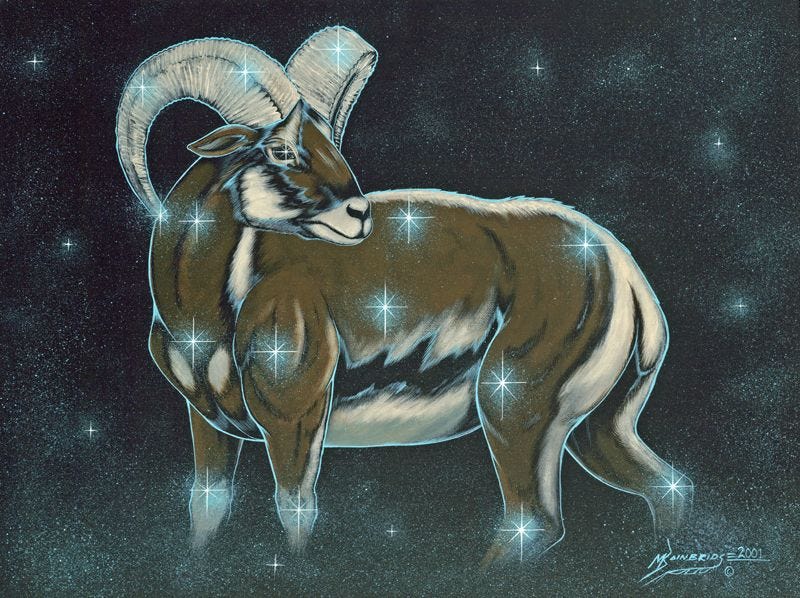
According to the Navajo, the Beehive cluster is Tsetah Dibé, which translates as Mountain Sheep Among the Rocks. It can be seen on moonless winter nights when it is overhead, and at those times, the cluster is used to time winter healing ceremonies, including the Nine Night Ceremony or Nightway. The cluster’s movement across the sky is used to tell time during the ceremony.
The Greeks called the cluster Phatne, ‘nebulous mass’ or ‘little mist’, and they used it for weather prediction. Based on its visibility, they believed it could forecast rain. It was said that if the cluster was not visible, but other stars were, it meant the weather would soon worsen, and storms were coming. But if the cluster shone clearly, the weather would be fine. An ephemeris from 1649 expands upon this:
‘If the cloud (nebula) called Proesepe, or the manger, standing betwixt the Aselli (two nearby stars) do not appear when the air is serene and clear, it foreshadows cold, foul and winterly weather. If the northernmost of these stars be hid, great winds from the south, but the other being hid, north-east winds.’ 1
Is there any truth to this folklore? I am not sure, meteorology is not my forte. If I had to guess, it could be that a rise in humidity associated with approaching rain could reduce the transparency of the air, and cause fainter stars such as the Beehive cluster to become invisible. Or maybe this is an effect of poor visibility (or seeing) caused by turbulent air, such as the rising winds associated with falling air pressure or an approaching weather front. Or maybe the omens associated with this cluster are fanciful speculation. Some adamantly believe that traditional weather lore has grains of truth to it, and it is known that Indigenous knowledge of observing the natural world deeply and fully can have just as much veracity as more ‘logical’ scientific methods, often confirming mainstream science later down the line. But as climate change alters our weather patterns into forms unrecognisable to those of our ancestors, those reliable omens of old may not have much credibility nowadays. And with light pollution completely obscuring the Beehive to our naked eye in all weathers, this celestial barometer may not be of use any more.
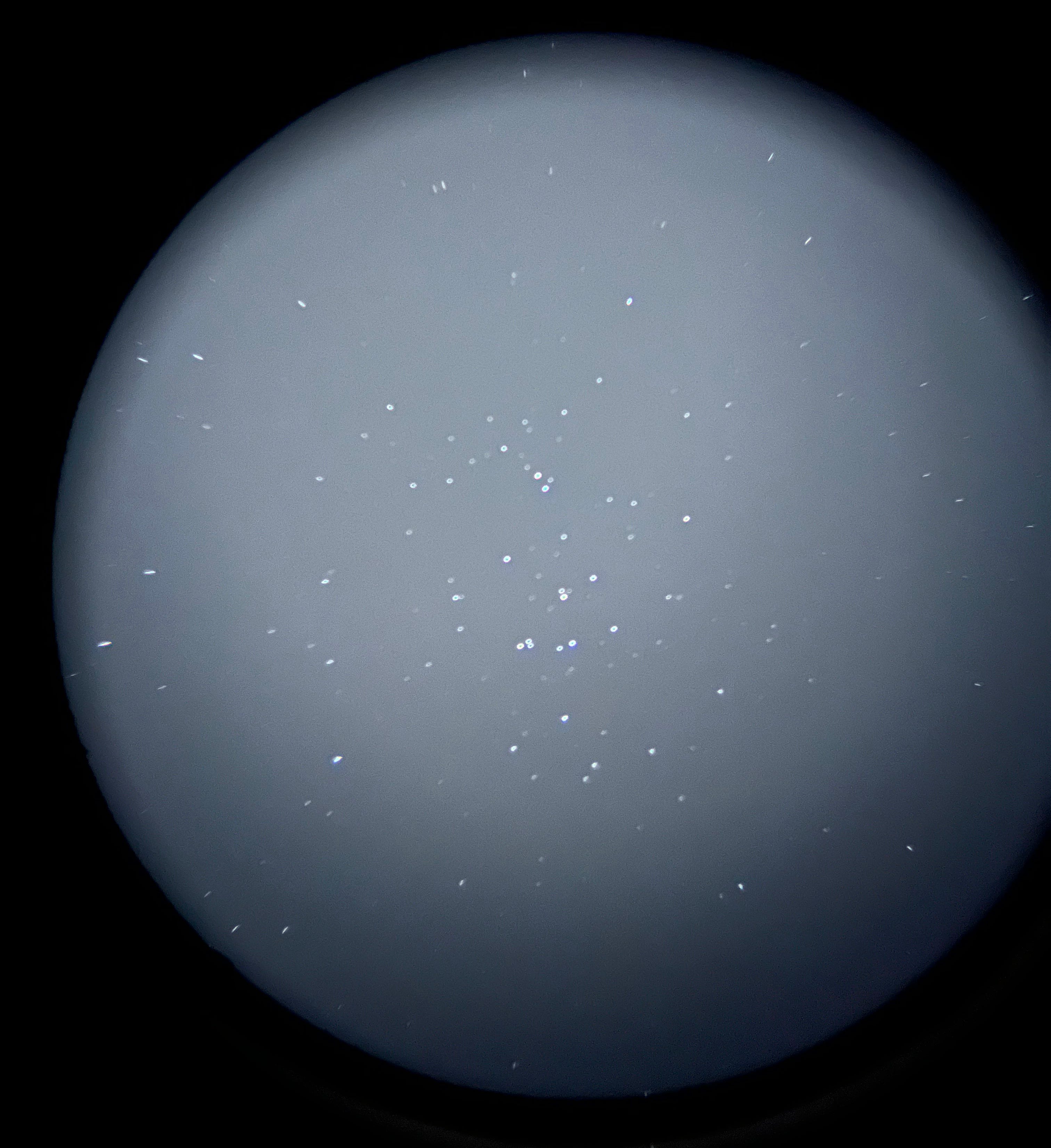
It was Galileo who first observed the cluster with a telescope and found it wasn’t a cloud at all, but made of many, many stars. The Beehive cluster is 12 light years wide and contains over 1000 stars, all 500-600 light years away. At 650 million years old, these stars are older than the more youthful blue Pleiades, and are a mix of young stars with older red giants and white dwarfs.
A lesser-known star cluster, M67, also lies in Cancer. Located near the star marking the crab’s left claw, this cluster is notable for being one of the oldest open clusters we know of, with the stars within being 5 billion years old. Interestingly, this is also the age of our Sun, and the stars in M67 are also similar in type and composition to the Sun. Nicknames for M67 include the King Cobra cluster or the Golden Eye cluster for the colour of its stars.
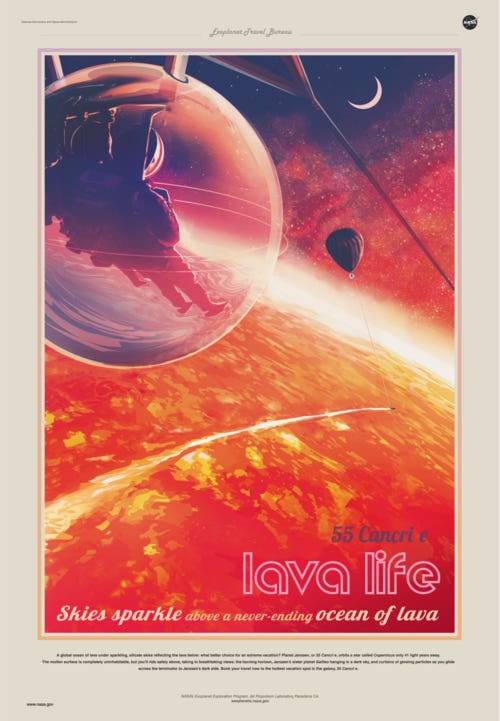
55 Cancri is a binary star system consisting of an orange star and a red dwarf, and both of them have their own set of planets in orbit around each other. Around the orange star, 55 Cancri A, there are five planets, and one of them, 55 Cancri e, is one of the most extreme exoplanets we know of. Twice as big as Earth, the planet has one of the fastest orbits known – a year there lasts only 17 hours and 40 minutes – and its closeness to the star means that it has an infernal surface temperature of 1760 C. Temperature variations across the planet indicate extra heating by volcanic activity, and an atmosphere rich in carbon monoxide and dioxide. It may be a ‘lava planet’ with a surface covered in molten rock, heated by the star and from within, but recent observations paint a picture of a planet that’s more like a ‘super-Venus’. Either way, it’s a truly hellish world!
If you want to track down Cancer in the sky, wait until the Moon is out of the way, and get yourself far from the city. Alternatively, binoculars will help you pinpoint these stars. And hope that the Beehive cluster is nicely visible and that it foretells fair weather.
Find out more
Dung beetles and the Milky Way
Spitzer Telescope: 55 Cancri
Inwards, Richard, ‘Weather Lore Volume II: Sun, Moon and Stars’, Papadakis Publisher, 2013, p.72
I never knew the scarab beetles navigated by the Milky Way. Thanks from an also history buff.